Order at a French bakery without guessing
Start with a greeting, name the bread or pastries and the quantity, then listen for whether the baker is offering something else or finishing the sale. A useful bakery order is a short exchange, not a perfectly memorized speech.


Quick answer
“Bonjour, deux croissants, s’il vous plaît” means “Hello, two croissants, please.” If you have finished, “Ce sera tout, merci” means “That will be all, thank you.” Learn those two turns together, then practice a change in quantity or an unavailable item.
In this guide
What the person behind the counter needs to know
A display full of unfamiliar names can make a simple purchase feel like an exam. You do not need to identify every pastry before joining the queue. Choose the item you actually want, check whether its label gives a name or a price, and decide how many you need. The person serving you can then work with a clear request rather than an explanation of your whole breakfast plan.
“Bonjour, je voudrais une baguette, s’il vous plaît” means “Hello, I would like a baguette, please.” The greeting opens the interaction; “je voudrais” expresses the request; the noun identifies the item. You can also say “Une baguette, s’il vous plaît” (A baguette, please) after greeting the person. The shorter version is still a request when the context and your tone make its purpose clear.
Keep the greeting separate enough that the baker can acknowledge you. Then give the item and number together. If there is a queue, being understandable is more helpful than rushing through a long sentence. If another customer is still being served, wait for the baker to turn to you before starting. You are practicing a shared interaction, not delivering a recording regardless of what happens around you.
A small order with a real ending
Here is an original exchange for buying breakfast to take away. Read the English first so you know what each person is trying to accomplish. Then cover that column and follow the French. The final customer line matters because it tells the baker that no more items are coming.
| Speaker | French | Meaning |
|---|---|---|
| Baker | Bonjour, vous désirez ? | Hello, what would you like? |
| Customer | Bonjour. Deux croissants et une baguette, s’il vous plaît. | Hello. Two croissants and a baguette, please. |
| Baker | Et avec ceci ? | Anything with that? |
| Customer | Ce sera tout, merci. | That will be all, thank you. |
| Baker | Voilà. | Here you are. |
| Customer | Merci, bonne journée. | Thank you, have a good day. |
Add an item or finish
Notice what the customer does not do: repeat the order after “Et avec ceci ?” The baker is inviting an addition. You can add something or end the order. A learner who only knows the opening sentence may mistake this for a request to start again. Practicing the likely next turn gives that first sentence somewhere to go.
For a second reading, change the order to “Un croissant et deux baguettes, s’il vous plaît” (One croissant and two baguettes, please). Keep the rest of the conversation flexible. The aim is to preserve the purpose of each turn while changing the information. You are not trying to reproduce both speakers’ words in exactly the same order.
Quantity is a separate skill from naming the pastry
Start with the numbers you need for one purchase. “Un croissant” is one croissant; “deux croissants” is two croissants; “trois croissants” is three croissants. “Une baguette” is one baguette. The article changes with the noun, but a practical first step is to learn each item with its article instead of interrupting every order to reconstruct a grammar rule.
The written plural does not give you permission to pronounce every final letter. Use French audio when you learn the item, and listen to the whole number-and-noun group. You can understand the difference between one and two without adding an English-style plural sound to the end of the word. For this purchase, clear quantity matters more than knowing the full plural system.
If the baker reaches for the wrong number, correct that one detail: “Deux, s’il vous plaît, pas trois” (Two, please, not three). You do not need to restart with a greeting and a full request. Say the number clearly and wait for the response. This is a useful example of the short-reply approach when you freeze: repair the smallest part that prevents the exchange from working.
Use the display when the name disappears
Pointing can support your words. “Celui-ci, s’il vous plaît” means “This one, please” for a masculine item; “celle-ci” is the feminine form. If that distinction is too much to retrieve in the moment, “Ça, s’il vous plaît” (That, please), with a clear gesture, is a simple conversational option. It identifies an object without requiring its name.
Do not point vaguely across several shelves and assume the person can see what you mean. Move your gesture toward the item, let the baker indicate it, and confirm “Oui, celui-ci” (Yes, this one) when that form fits. If you know the label, reading it aloud is another way to help. A mispronounced specific name may communicate more than a fluent but ambiguous request.
When several versions look alike, ask a narrow question. “C’est au chocolat ?” means “Is it chocolate?” “Qu’est-ce qu’il y a dedans ?” means “What is inside?” The second question may produce a longer answer, so use it when you are ready to ask for a repeated ingredient. For a serious dietary requirement, communicate the actual requirement and check directly; a picture or a familiar pastry name is not an ingredient guarantee.
When the item you wanted is unavailable
“Il n’y en a plus” means “There aren’t any left” in this context. You might also hear a shorter “On n’en a plus” (We don’t have any left). The important part of the response is that repeating the same order will not make it available. Decide whether to ask for an alternative or finish with the other items you already chose.
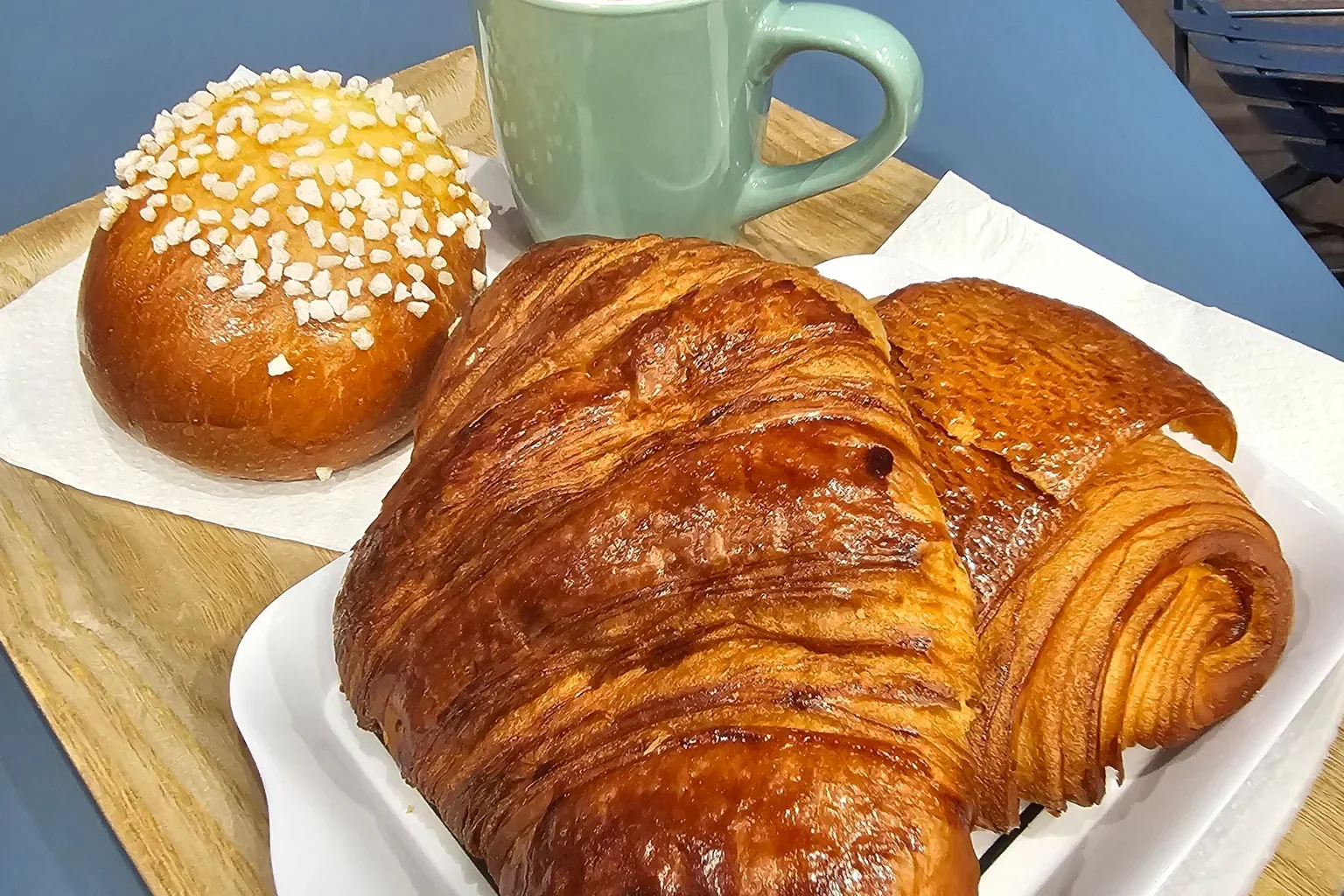
“Vous avez des pains au chocolat ?” means “Do you have pains au chocolat?” The French name refers to a chocolate-filled pastry. It is useful to recognize the actual label in front of you rather than treating an English translation as the product’s local name. If the answer is yes, follow with a quantity: “Deux, s’il vous plaît” (Two, please). If not, you can choose something visible.
A complete change might be “Alors, un croissant, s’il vous plaît” (Then, one croissant, please). “Alors” connects the new choice to the unavailable first choice. After that, let the baker continue. Do not apologize at length for choosing another item. The transaction already contains a natural reason for changing your mind, and a short replacement request is enough to move it forward.
For the difference between "not", "nothing" and "not anymore", practice the replies in French negation.
Recognize the question that changes the packaging
Some bakeries also have seating or sell food meant to be eaten immediately. “Sur place ou à emporter ?” means “For here or to take away?” Answer “À emporter, s’il vous plaît” (To take away, please) if you want the order packaged to leave. “Sur place” (For here) answers the other option. Neither phrase gives an additional food order.
You may not hear this question during a simple bread purchase. Do not force it into every exchange because it appeared in a guide. Instead, learn to recognize it if it occurs. Real transactions differ by shop, product, and the way the counter is organized. Your task is to connect a question with the kind of answer it needs, not to make the shop follow a script.
Try a listening drill with three English intentions written on paper: add an item, choose packaging, finish the order. Read “Et avec ceci ?” (Anything with that?) and “Sur place ou à emporter ?” (For here or to take away?) in alternating order. Point to the intention before answering. The listening-for-meaning guide explains how to build this kind of focused listening task.
Finish the purchase without guessing the total
“Ça fait combien ?” means “How much is it?” Use it if you need to ask for the total. If you missed the answer, “Vous pouvez répéter le prix, s’il vous plaît ?” means “Could you repeat the price, please?” Asking for the price again is different from asking the person to repeat the entire order. Name the missing detail so the repair stays manageable.
You can ask “Je peux payer par carte ?” (Can I pay by card?). The response tells you about this purchase at this shop; it does not establish a rule for every bakery. Look at the displayed amount before paying and ask about anything you do not understand. In practice exercises, use invented totals and label them as examples rather than learning an old price as if it were current.
To close, “Merci, au revoir” means “Thank you, goodbye.” “Bonne journée” means “Have a good day.” You do not need several farewell formulas in a row. Choose one you can say comfortably, collect your order, and leave space for the next customer. The skill is completing a small interaction with shared understanding, not fitting every polite expression you know into it.
Rehearse three different purchases
For the first round, choose two familiar items and do not change them. Concentrate on greeting, giving quantities, and ending the order. Hide the French after reading it once and answer from the situation. If you need a prompt, reveal only the missing word, not the whole conversation. That lets you distinguish a vocabulary gap from forgetting the purpose of your turn.
For the second round, make one item unavailable. Replace it with something else or keep only the remaining item. For the third, have the baker ask about packaging. Change the order of the follow-up questions so you have to listen. A partner can play the baker, but you can also write three question cards, shuffle them, and respond to whichever you draw.
Afterwards, record one useful correction rather than rewriting the entire guide into a notebook. Our mistake-review routine helps you turn that correction into the next session. If deciding how to address the baker was the difficult part, read tu and vous in everyday French. For a different listening challenge, try French station announcements, where the useful detail may be a platform or a delay.
Common questions
Do I have to say je voudrais every time?
No. “Je voudrais” means “I would like” and is useful for a polite request, but a greeted order such as “Deux croissants, s’il vous plaît” (Two croissants, please) can be natural too. Keep the greeting, clear quantity, and polite tone rather than making every sentence longer.
Should I use tu or vous with the baker?
“Vous” is a sensible starting point with an unfamiliar adult in a customer-service exchange. Local relationships may be more familiar, but you do not need to guess that on a first visit. Use “s’il vous plaît” (please) consistently with that choice.
What if I cannot pronounce the pastry name?
Point clearly, use the label if you can, or say “Ça, s’il vous plaît” (That, please). Confirm the item the baker indicates before adding the quantity. The goal is selecting the right pastry, and speech can work together with a gesture.
Does et avec ceci mean I made a mistake?
Usually it is an invitation to add something: “Anything with that?” If your order is complete, answer “Ce sera tout, merci” (That will be all, thank you). If you want another item, give its name and quantity instead of repeating everything.
Sources and further reading
More practice guides
 French · Listening and travel 9 min read
Understand the useful part of a French train announcement
Understand French train announcements by finding the destination, platform, and delay. Practice original examples, clear questions, and useful replies.
Read the guide French · Grammar in conversation 9 min read
Tu or vous? Choose the French you that fits
Choose tu or vous in French, keep verbs and possessives consistent, and handle a change in formality through original scenes, translations, and practice.
Read the guide AI conversations 10 min read
How to practice a language with AI roleplay
Set up an AI language roleplay you can finish. Choose a situation, define your goal, and leave room for a follow-up question with this practical exercise.
Read the guide