How to practice listening for meaning
To practice listening in another language, choose a short recording and decide what you need to understand before you press play. Listen for that information, check the relevant passage, and replay it without the transcript.

Quick answer
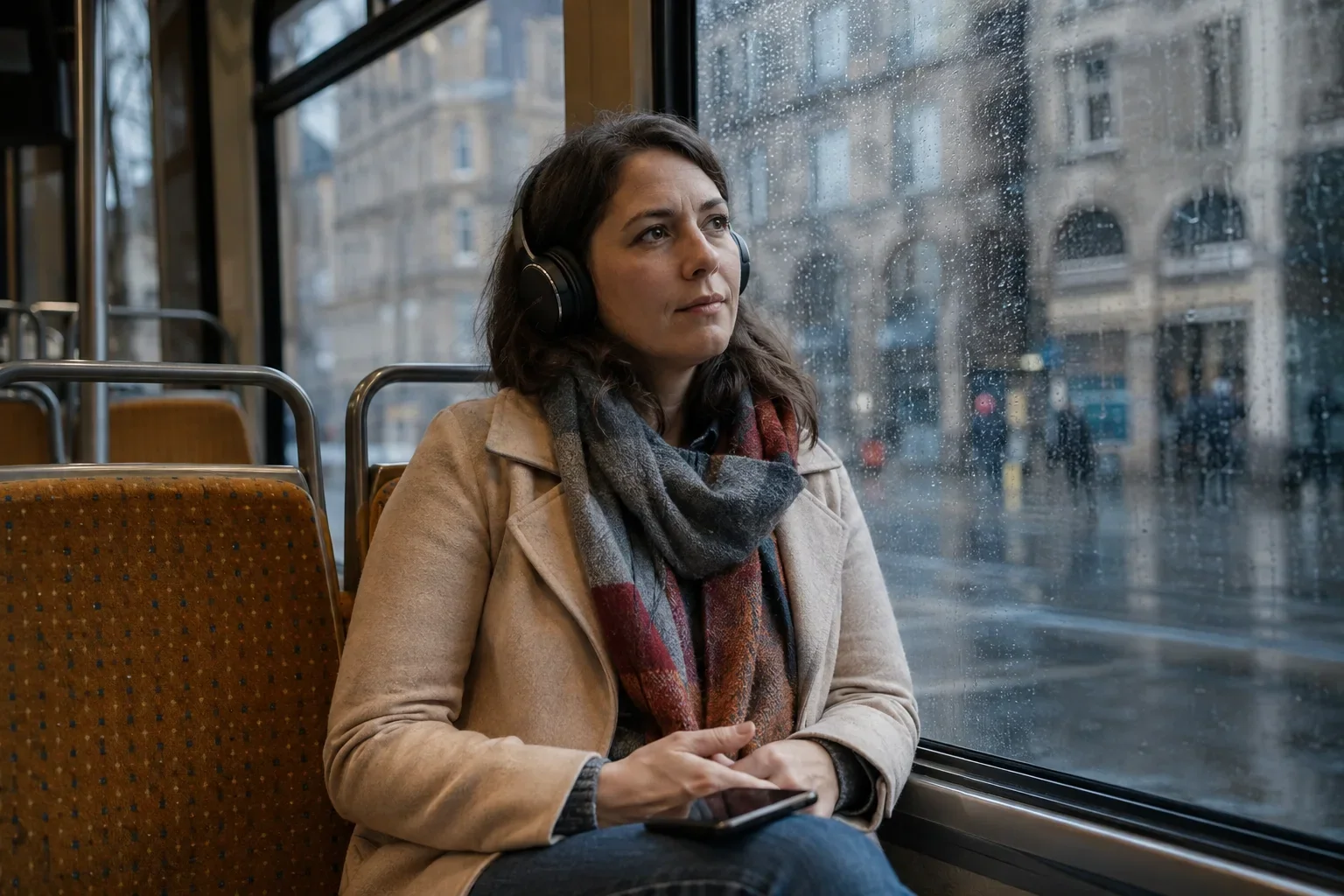
Start with a recording that has a reliable transcript and a familiar situation. Ask one question, such as where someone is going or which time they choose. Listen once, note what you understood, then use the transcript to identify the missing part. Replay it and answer the speaker yourself. Increase the difficulty by changing one feature at a time.
In this guide
Decide what successful listening means today
Understanding an entire recording is a broad goal. It can leave you disappointed even when you caught the information you needed. A narrower goal makes the session easier to inspect. Can you identify the destination, understand why the speaker is calling, or tell which of two options they prefer?
Choose the question before listening. A café conversation might ask which drink is ordered. A hotel exchange might ask when breakfast begins. A short personal introduction might ask where the speaker is from. Each gives your attention a job without requiring you to translate the whole passage.
You can use English for your note. If the exercise is about understanding sound, having to write an elaborate answer in the learning language adds another demand. A place name, a sketch, or a brief explanation may be enough to show what you heard.
The British Council's listening guidance distinguishes understanding the main idea from understanding every word. Use that distinction carefully. The goal is to identify the information relevant to your task, not to assume unfamiliar details never matter. A missed negative or number can change the answer.
Choose a recording small enough to work with
For close practice, use a short exchange with a clear situation and a reliable transcript. A lesson dialogue or a small part of a longer recording can work. You should be able to locate the difficult moment again without searching through several minutes of unrelated speech.
Familiar subject matter reduces the number of things you need to figure out. If you are learning how to make an order, choose an order rather than a fast debate about an unfamiliar topic. You can work with more demanding material later, but the first recording should give you something you can understand and build on.
Check the audio quality before judging your listening. Background music, a distant microphone, overlapping speakers, and poor compression can obscure speech. Those are real-world conditions, but adding all of them at once can hide whether you need vocabulary practice or simply a clearer recording.
For longer enjoyable listening, choose content you want to return to. Keep that separate from this close-listening exercise. You can listen to a story for interest and still use a short lesson exchange for careful work on a particular question.
| If this is difficult | Try this adjustment |
|---|---|
| Almost every sentence is unfamiliar | Choose a more familiar topic or a simpler lesson. |
| You lose track during long turns | Use a shorter excerpt with one speaker turn. |
| You understand the text but not the sound | Replay one phrase while checking its written form. |
| Several people speak at once | Begin with a clear two-person exchange. |
| You understand everything immediately | Ask a more detailed question or try a new speaker. |
Listen once before opening the transcript
Keep the transcript closed for the first attempt if the material is within reach. Read your question, press play, and let the recording finish. Write the answer you think you heard and mark anything uncertain. “Friday, possibly at six” is a more useful note than “I understood most of it.”
Do not pause after every unfamiliar word on this first pass. That can turn a conversation into a chain of disconnected fragments. Listen for the overall situation and the part that answers your question. You will have another chance to examine individual words.
If you cannot identify even the general situation, use a small amount of support. Read the title, look at a relevant image, or learn the two words necessary to understand the task. Then try again. You do not have to preserve the difficulty of an exercise that currently gives you no useful foothold.
Notice the difference between a confident answer and a correct one. Check the actual passage rather than assuming familiarity with the topic proves you heard the detail. A restaurant conversation can sound familiar while still containing an unexpected choice.
Use the transcript to explain one gap
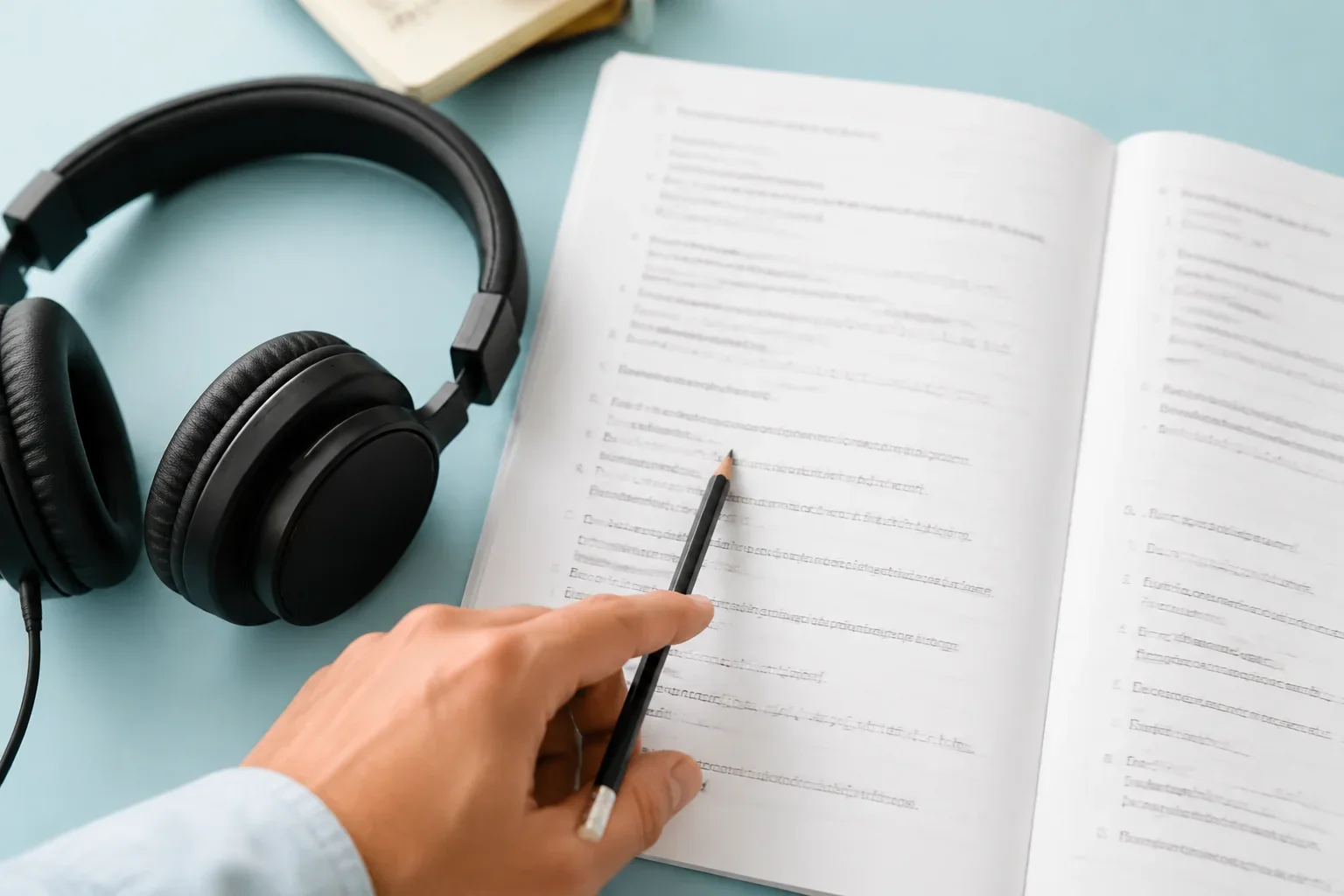
Open the transcript after you have an answer or a clearly identified uncertainty. Find the sentence that contains the information you need. Compare what you thought you heard with what was said. Try to name the difference before looking up additional vocabulary.
If you recognize every written word, the difficulty may lie in how the words sound together. Replay the passage while following the text, then close the text and replay it once more. Listen for the whole phrase rather than trying to force a separate gap between every written word.
If the written sentence is also unclear, work on its meaning first. Look up the important word or ask for an explanation of the construction. Listening repeatedly to an unknown expression may make its sound familiar without telling you what it communicates.
A transcript is a tool for locating a problem. It does not need to remain visible for the whole session. Remove it for the final listen so you can notice whether the sound now carries more of the meaning by itself.
Separate a missed word from a missed relationship
You may know the words and still misunderstand how they fit together. A reply might reject the first option and choose the second. A speaker may describe what happened yesterday before explaining today's plan. Listening only for familiar nouns can miss those relationships.
Pay particular attention to a change of choice, a contrast, a reason, or a negative. If you hear two times, ask which one the speakers finally agree on. If you hear a place name, ask whether the person is going there, leaving there, or comparing it with somewhere else.
Use a simple evidence check: which part of the recording supports your answer? Point to the phrase in the transcript, then replay it. This prevents a plausible guess from becoming the main thing you remember about the exercise.
The same issue appears in conversation. A person may answer your opening request with a question of their own. Our AI roleplay guide leaves space for those follow-ups, so you have to respond to the actual turn rather than the reply you expected.
Replay with a purpose, then stop
Give each replay a job. On one, find the missing word. On another, hear how the phrase is grouped. On the final replay, answer the original question without the text. Replaying the same audio while attention drifts does not tell you much about what changed.
You do not need an exact replay count. A short phrase may become clear quickly; another may require a separate lesson on its vocabulary. Stop when you can explain the answer and identify the part that supports it, or when you have found a gap that needs a different kind of practice.
If slowing the audio helps you locate a sound, use it temporarily. Return to the recording's original speed to check the phrase in context. Speed controls change the task, so keep track of whether your final understanding still depends on the slower version.
For a brief daily session, choose one uncertain detail to resolve rather than trying to master a whole recording. The 10-minute Spanish routine shows how a small listening task can sit alongside recall and a speaking turn.
Answer the person you just heard
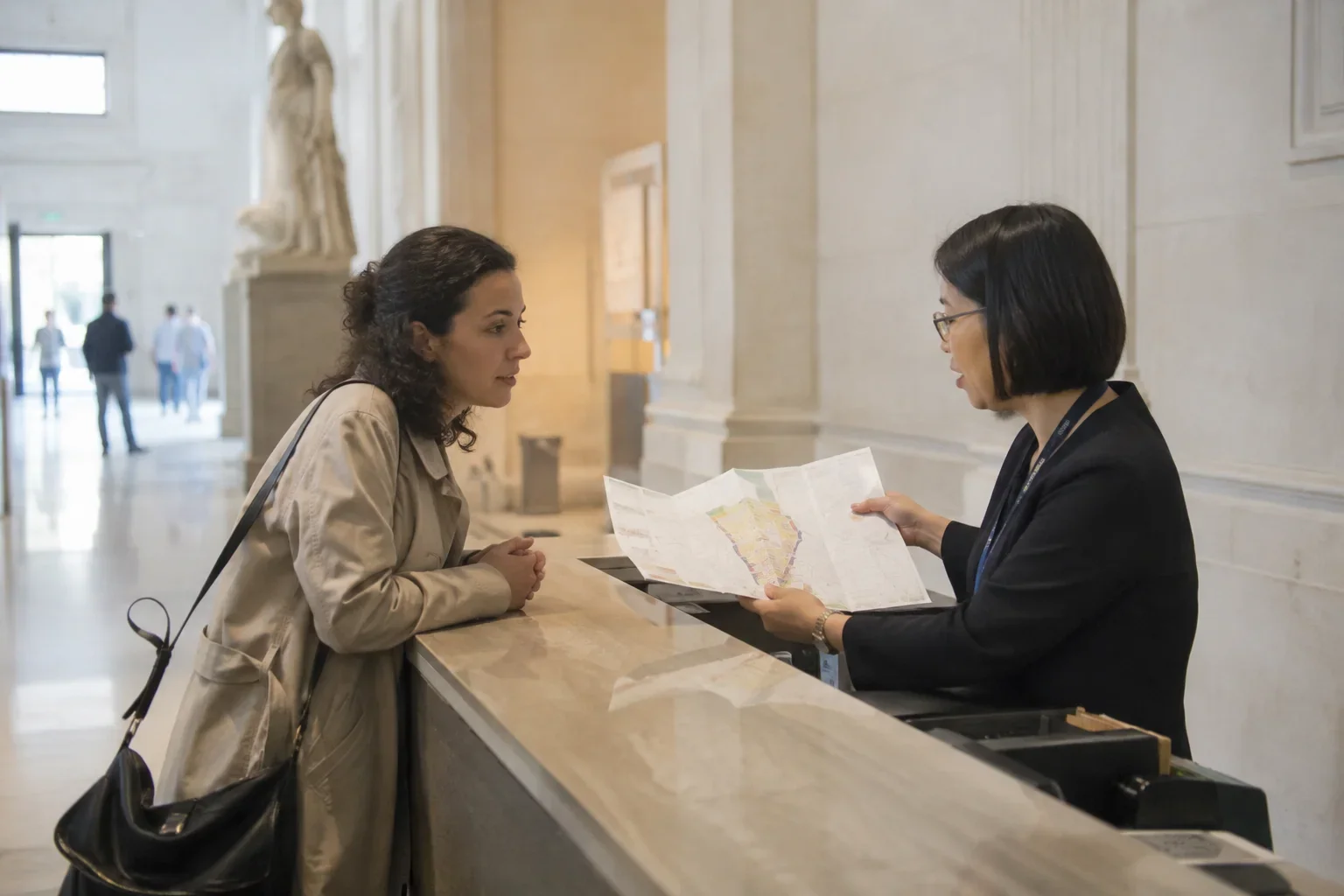
Once you understand the exchange, take a turn yourself. If the speaker asks where you want to go, give a destination. If they offer two times, choose one. This connects listening with the purpose of the conversation without requiring a long speech.
Begin with the answer that fits the original recording. Then change a detail you already know how to express. You could choose a different drink, change the number of people, or ask the speaker to repeat the time. Avoid introducing several new words just to make the exercise look different.
For Spanish, the directions guide gives short replies involving turns and landmarks. The asking-for-help guide covers repetition and clarification when the reply is still unclear.
Yapkin includes focused listening work and guided conversations. Use the listening activity to inspect what you heard, then use a speaking turn to respond. Reading an explanation is useful support, but it should not silently replace the listening task you intended to do.
For a French text warm-up, use the negative-reply exercises. Distinguish "not yet" from "no longer" before trying to identify those meanings in a recording.
Choose the next recording from what you learned
Write a short note about the session: the question, your first answer, the checked answer, and the part that caused trouble. You do not need a transcript of your whole study process. Keep enough information to choose the next useful recording.
If the difficulty was a number, try another exchange with times or quantities. If it was a familiar phrase spoken differently, listen to another speaker using similar language. If the vocabulary was mostly unknown, spend some time learning the useful words before increasing the audio difficulty.
The Open University's language-learning course treats goals and resource selection as part of independent learning. Apply that idea to the next clip: choose it because it addresses a need, not because it is longer or carries a more advanced label.
You can revisit the original recording after a gap. A familiar passage can show whether the explanation stayed available, while a new passage shows whether you can use the skill with different wording. Both are useful, provided you know which question you are asking.
Keep difficult listening from taking over the session
If you become stuck on one unclear sound, move back to meaning. What information is missing, and does it affect the task? Some details deserve a careful check; others can wait until you have understood the main exchange.
Ask for help when repeated listening is no longer changing your understanding. A teacher or a reliable transcript can resolve a word that an automatic caption has misheard. Do not build a practice card around uncertain text simply because it appeared in subtitles.
When a live conversation moves too quickly, use the recovery options in what to do when you freeze. Asking for the last detail again is often more manageable than asking the person to repeat everything they have said.
Put this into practice with French train announcements, directions in Brazilian Portuguese, questions at a German bakery, or Italian station information. Each guide gives you a specific detail to identify before deciding what to do next.
Common questions
Should I listen with or without subtitles?
For close practice, try one listen without them, then use a reliable transcript to locate the gap. Finish with another listen without the text. If the material is currently too difficult to follow at all, use support earlier or choose a simpler recording.
Do I need to understand every word?
You need the information that answers your listening question. Missing a descriptive word may not change that answer, while missing a negative, time, or choice can. Check the relevant passage instead of judging comprehension by the percentage of words that felt familiar.
Is slowing down audio useful?
It can help you locate a difficult phrase. Use it as temporary support and return to the original recording speed afterward. If you need very slow playback for every sentence, a clearer or more familiar recording may be a better starting point.
How long should a listening session last?
Long enough to attempt a question, inspect an uncertainty, and listen again. The suggested workflow can fit a short session, but there is no universal number of minutes that guarantees improvement. Choose a passage you can work with attentively in the time available.
Why can I read a sentence but not hear it?
Knowing a written form does not necessarily mean you recognize it in connected speech. Compare a short phrase with reliable audio, follow the text once, then remove it. Check that the recording quality and the speaker's pace are not adding avoidable difficulty.
Sources and further reading


More practice guides
 AI conversations 10 min read
How to practice a language with AI roleplay
Set up an AI language roleplay you can finish. Choose a situation, define your goal, and leave room for a follow-up question with this practical exercise.
Read the guide Speaking 9 min read
What to do when you freeze mid-sentence
Keep a conversation moving when a word disappears. Try a shorter reply, ask for help, and rehearse a small interruption in the language you are learning.
Read the guide Review 9 min read
Make a mistake useful in your next conversation
Turn language mistakes into useful speaking practice. Check corrections, choose what to review, and build prompts that help you use the right phrase next time.
Read the guide German grammar 10 min read
German question words that fit the answer
Choose German question words for the answer you need. Compare wo, wohin and woher, check word order, and practice original questions with translated replies.
Read the guide Italian conversations 10 min read
Mi piace or mi piacciono?
Choose mi piace or mi piacciono from what you like, ask a friend, answer naturally and agree on a plan. Includes examples and five practice tasks in Italian.
Read the guide