Ask for directions in Brazilian Portuguese
You ask where the café is and receive a helpful answer containing six things you did not catch. The solution is not a longer opening question. Learn to ask for one short route, recognize its turning point, and confirm the part you need before walking away.


Quick answer
“Onde fica a farmácia?” means “Where is the pharmacy?” For a route, ask “Como eu chego lá a pé?” (How do I get there on foot?). Listen for a direction, a landmark, and whether your destination is before or after it.
In this guide
Choose a destination the other person can identify
“Onde fica…?” is a useful opening for asking where something is. “Onde fica a estação?” means “Where is the station?” If there is more than one station nearby, add its name. A grammatically correct question can still be unclear when its destination is ambiguous. Show the name on your phone if pronunciation makes it hard to recognize.
Begin with “Com licença” (Excuse me) to get someone’s attention. Then ask the question and leave room for the answer. “Com licença, onde fica esta rua?” means “Excuse me, where is this street?” It works with a street name you are pointing to. You do not have to read an entire address aloud before establishing whether the person knows the place.
Distinguish a named destination from a category. “Tem uma farmácia por aqui?” means “Is there a pharmacy around here?” You are asking for a nearby option, not necessarily one particular shop. That difference affects the answer. Someone may point to a different pharmacy that solves your problem, even though it is not the name you originally looked up.
Ask for a walking route, not just a location
“Como eu chego lá?” means “How do I get there?” Add “a pé” (on foot) if you are walking. Otherwise, the person might describe a route that makes sense by car or suggest public transport. Stating how you are travelling is a small addition that can prevent a much larger misunderstanding later in the exchange.
“É longe?” means “Is it far?” This gives a broad impression, but “Quanto tempo leva a pé?” (How long does it take on foot?) asks for a more useful estimate. Treat the answer as that person’s estimate, not a guaranteed journey time. You may walk at a different pace or need extra time to find the correct entrance.
If the answer is a bus route and you want to walk, clarify “Dá para ir a pé?” (Can I get there on foot?). That asks whether walking is practical in this situation. It does not imply that every route is suitable for pedestrians. Check the actual surroundings, crossings, and access rather than following a phrasebook instruction into a place where walking is not permitted.
Three pieces of information make a usable route
Break a short answer into movement, landmark, and destination. In “Siga em frente até a praça” (Go straight ahead as far as the square), the movement is straight ahead and the square is the point where you stop following that instruction. The word “até” (until/as far as) connects the movement with its limit.
“Depois, vire à direita” means “Then, turn right.” “Depois” marks the next step. If you missed the first landmark, understanding the right turn alone is not enough: you do not know where it belongs. Ask for the missing landmark rather than collecting more directions you cannot attach to the route. This is a sequencing problem as much as a vocabulary problem.
Finally, “Fica à esquerda” means “It’s on the left.” That describes where the destination is, rather than necessarily telling you to make another left turn. Listen to the verb and the scene together. A building can be on your left while the walking route continues straight. Confusing its position with a turning instruction can send you down the wrong street.
Build a small direction key
Use the following phrases as labels on a sketch, not as a list to recite. Draw an arrow for each movement and a small square for a landmark. Pair the Portuguese with a physical direction so that you can recognize its meaning without translating a long sentence in your head.
| Portuguese | Meaning in a route | What to mark |
|---|---|---|
| Siga em frente. | Go straight ahead. | A straight arrow |
| Vire à direita. | Turn right. | A right turn |
| Vire à esquerda. | Turn left. | A left turn |
| Atravesse a rua. | Cross the street. | A crossing |
| Na esquina. | At the corner. | A corner |
| Depois do banco. | After the bank. | A point beyond the bank |
| Antes da praça. | Before the square. | A point before the square |
Follow the movement
You may also hear “reto” used for “straight.” Learn to recognize both “siga em frente” and an instruction containing “reto” without assuming there is one mandatory way to give directions. The map remains the same even when the speaker chooses different wording. Your goal is matching language to movement, not checking whether someone used the phrase you expected.

Before and after can change the final answer
Suppose you understand the street and the bank, but not whether the café comes before or after the bank. Ask “É antes ou depois do banco?” (Is it before or after the bank?). The question offers the two possibilities explicitly. A short answer can now resolve the route without requiring the speaker to explain every earlier step again.
“Em frente ao banco” means “opposite/in front of the bank,” depending on the spatial context. It is not the same phrase as the instruction “siga em frente” (go straight ahead). Pay attention to what follows “em frente.” In a location description, the named building provides the reference point. On a real street, confirm which side or entrance the person is indicating.
“Perto de” means “near,” and “ao lado de” means “next to.” Near a square could describe several streets; next to a particular pharmacy is narrower. Ask for the more specific relationship when the broad landmark leaves too many possibilities. You are helping the speaker choose a level of detail that matches what you can currently see.
Confirm the route in one sentence
Here is an original short exchange. The square, bank, and café are imaginary landmarks for practice. The learner repeats the crucial turn and asks one final location question. That is enough to check the route without echoing every word the other person said.
“Com licença, como eu chego ao café a pé?” means “Excuse me, how do I get to the café on foot?” The answer is “Siga em frente até a praça. Vire à esquerda. O café fica depois do banco” (Go straight ahead to the square. Turn left. The café is after the bank). There are three connected pieces, not one indivisible instruction.
The learner responds “À esquerda na praça?” (Left at the square?). After confirmation, they ask “Do mesmo lado do banco?” (On the same side as the bank?). These questions test the parts that determine the last stretch of the walk. You can use the short-reply technique for speaking blocks to practice this kind of compact confirmation.
Repair the answer while you are still together
“Pode falar mais devagar?” means “Could you speak more slowly?” It is useful when the whole delivery is too fast. If you missed only a name, ask “Qual é o nome da rua?” (What is the street’s name?). Naming the missing information makes it easier for the person to give a useful answer on the next attempt.
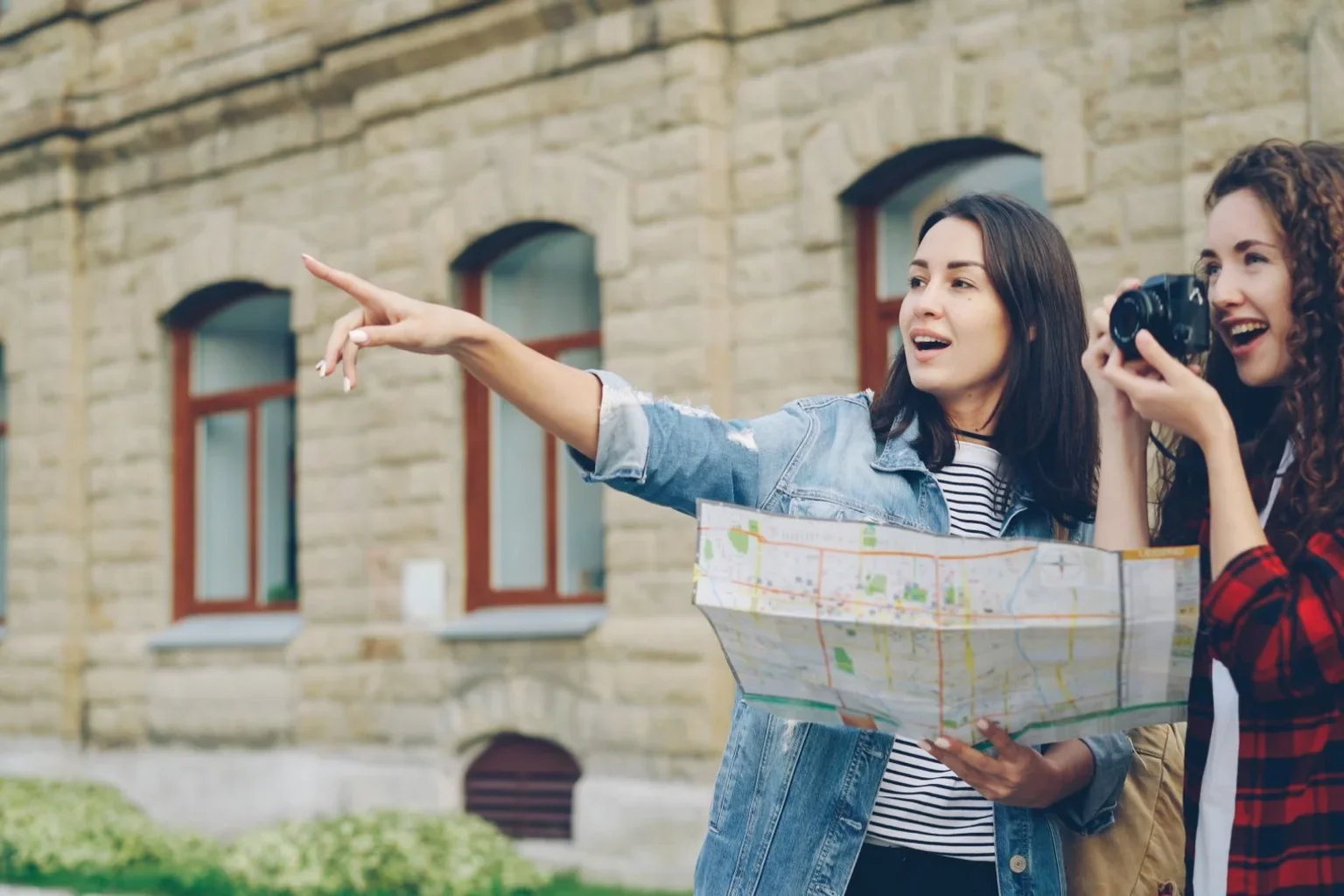
“Pode me mostrar no mapa?” means “Could you show me on the map?” A map gives both people a shared reference. Keep the destination visible and check your starting point before following a drawn route. If the map is rotated, a gesture toward the top of the screen may not correspond to the direction you are facing on the pavement.
You can also ask “É esta rua?” (Is it this street?) while indicating a specific street. Avoid pointing between two possible roads and accepting an uncertain nod as a complete answer. A small clarification now is easier than trying to reconstruct the exchange after several wrong turns. Thank the person once you have enough information to continue.
Know when the route has become a transport question
“Onde fica o ponto de ônibus?” means “Where is the bus stop?” This is a new destination question, even if taking a bus is only one part of your longer trip. First find the stop, then check the service you need. Combining the stop, bus number, ticket, and final street into one hurried question can produce more detail than you can use.
“Este ônibus vai para o centro?” means “Does this bus go to the city centre?” The answer concerns this service, not every bus at the stop. Route names, payment arrangements, and access rules vary. Look for current local information and confirm the vehicle or direction before boarding. The language skill is asking precisely enough to identify the relevant service.
If a friend is meeting you, send a location update with a recognizable landmark: “Estou na praça, perto do banco” (I’m in the square, near the bank). Our guide to making plans in Brazilian Portuguese covers agreeing on a meeting point. A location update is useful only when both people mean the same square and the same side of it.
Draw a route that someone else can follow
Make a practice map with a starting point, two intersections, a bank, a square, and a café. Put the café after the bank in your direction of travel. Write three short instructions in Portuguese, then trace the route with your finger. Check that each turn occurs at an identifiable place and that the destination description matches the drawing.
For a second map, move the café before the bank and keep the rest unchanged. The important correction is now “antes” instead of “depois.” This makes the exercise test a meaningful difference. For a third round, cover the drawing and listen to someone read your instructions. Rebuild the route from what you hear using the listening practice guide.
Record the one contrast that caused trouble with our mistake-review routine, then revisit it on a fresh map. You can make the café a padaria and continue with ordering breakfast in Brazil. That gives the walking task a concrete destination while keeping the directions exercise focused on finding it.
Common questions
What is the difference between onde fica and como eu chego?
“Onde fica?” asks where a place is. “Como eu chego?” asks how to get there. Add “a pé” (on foot) when you want walking directions, and name the destination clearly if there are several similar places nearby.
How do I ask whether a place is within walking distance?
“Dá para ir a pé?” means “Can I get there on foot?” For an estimate, ask “Quanto tempo leva a pé?” (How long does it take on foot?). Use the answer together with current local conditions and your own needs.
Does em frente always mean straight ahead?
No. “Siga em frente” is an instruction to go straight ahead. “Em frente ao banco” describes a position relative to the bank, often opposite it. Listen to the complete phrase and use the visible layout to confirm the relationship.
What should I ask if I understood only half the route?
Name the missing part. “À direita ou à esquerda?” means “Right or left?” “Antes ou depois do banco?” means “Before or after the bank?” These questions often produce a more manageable answer than asking for the whole route again.
Sources and further reading
More practice guides
 Portuguese · Grammar in conversation 11 min read
Por vs para in Brazilian Portuguese
Learn por vs para in Brazilian Portuguese with everyday examples, clear translations, pelo and pra forms, and practice questions with answers you can explain.
Read the guide Portuguese · Food and drink 9 min read
Order breakfast at a Brazilian padaria
Order breakfast at a Brazilian padaria with useful Portuguese for coffee, pão na chapa, preferences, and paying, plus translated replies to practice aloud.
Read the guide Portuguese · Friends and plans 9 min read
Make plans in Brazilian Portuguese
Make plans with friends in Brazilian Portuguese, suggest a time and place, handle a late arrival, and practice natural replies with translated examples.
Read the guide AI conversations 10 min read
How to practice a language with AI roleplay
Set up an AI language roleplay you can finish. Choose a situation, define your goal, and leave room for a follow-up question with this practical exercise.
Read the guide