Order breakfast at a Brazilian padaria
At a Brazilian padaria, you might be choosing breakfast to eat there rather than simply buying bread to carry home. That changes the conversation: someone may ask about your coffee, prepare a hot item, or direct you to a separate place to pay. Learn to handle those choices one at a time.

Quick answer
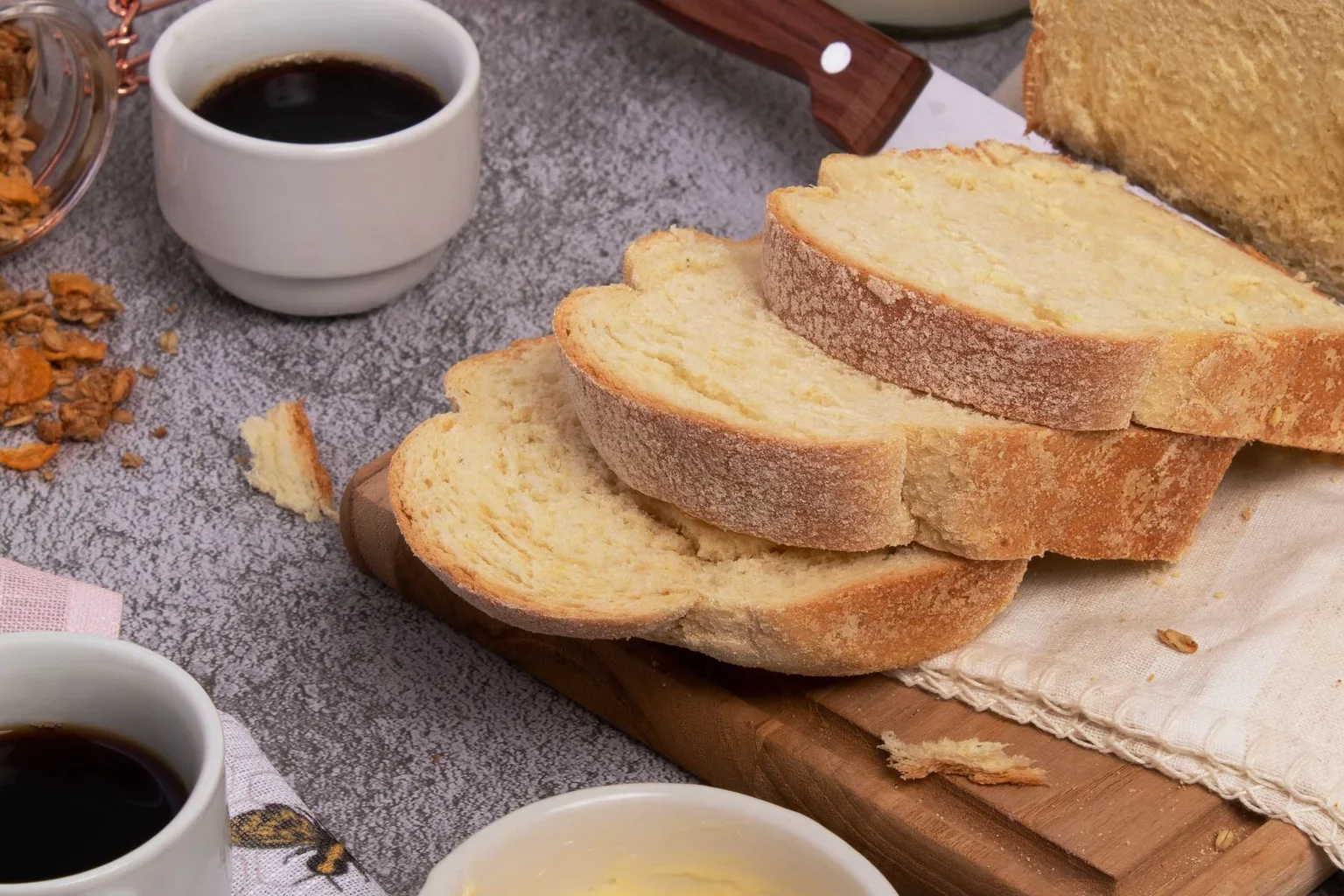
“Um café com leite e um pão na chapa, por favor” means “A coffee with milk and a buttered griddled bread roll, please.” Follow the shop’s questions about preparation, where you will eat, and payment rather than assuming every padaria works the same way.
In this guide
Start with the breakfast you actually want
“Café da manhã” means “breakfast,” while “café” alone usually refers to coffee in an order like the examples here. “Padaria” means “bakery.” A padaria may sell prepared food as well as bread, but its menu and service arrangement determine what you can order. Look at the counter or menu before trying to use every breakfast word you have learned.
Choose one drink and one food item for your first practice order. “Um café com leite, por favor” means “A coffee with milk, please.” “Um pão na chapa, por favor” requests a bread roll prepared on the griddle, commonly with butter. Learning these as menu items gives you a useful starting point; you can ask about a particular shop’s preparation if it matters to you.
Open with “Bom dia” (Good morning), then give your order when the person is ready. If you are still choosing, “Só um momento, por favor” means “Just a moment, please.” That is a complete and useful turn. You do not have to fill the pause with an explanation of why the display or menu is unfamiliar.
Separate the drink name from its details
“Café com leite” names coffee with milk, but it does not tell you every detail of cup size or proportion at every establishment. “Pingado” is another name you may encounter for coffee with some milk. Usage and preparation can differ. If a particular balance matters to you, ask about it instead of treating a regional name as a universal recipe.
“Tem mais leite ou mais café?” means “Does it have more milk or more coffee?” You can also state a preference: “Com pouco leite, por favor” (With a little milk, please). The request gives the server something specific to work with. It is more useful than repeating the drink name louder when the uncertainty is really about its ingredients or proportions.
“Sem açúcar” means “without sugar.” “O açúcar está na mesa” means “The sugar is on the table.” These two phrases do different jobs: one expresses your preference and the other explains where something is. Listen for whether the server is asking how to prepare the drink or telling you how to finish it yourself after it arrives.
Read the food choice as a menu item
“Pão de queijo” is the name of a Brazilian cheese bread, often made with cassava starch. It is a different item from “pão com queijo” (bread with cheese). The small word between the nouns matters. You should not assume that substituting “com” for “de” leaves the order unchanged just because both expressions contain the words bread and cheese.
“Pão na chapa” refers to bread prepared on a griddle. If you want to ask about butter, “Vai manteiga?” means “Does it come with butter?” in this context. “Sem manteiga, por favor” means “Without butter, please.” Whether the kitchen can accommodate a change is a separate question; ask and wait for the answer before treating it as agreed.
Other labels may include “bolo” (cake), “queijo” (cheese), and “presunto” (ham). Choose from the actual options in front of you. A familiar name or photograph cannot confirm every ingredient or preparation detail. If you need to avoid an ingredient, say which one and discuss the real item with the staff rather than relying on the general category name.

Follow a breakfast order through its choices
In this original exchange, the learner orders two items and answers a question about where to eat. The server’s final line concerns where the customer should go next. It is not another question about the food. Practice identifying that shift before trying to say every line quickly.
| Speaker | Portuguese | Meaning |
|---|---|---|
| Customer | Bom dia. Um café com leite e um pão na chapa, por favor. | Good morning. A coffee with milk and a griddled bread roll, please. |
| Server | Para comer aqui? | To eat here? |
| Customer | Isso, para comer aqui. | That’s right, to eat here. |
| Server | Com manteiga? | With butter? |
| Customer | Sim, por favor. | Yes, please. |
| Server | Pode sentar ali. | You can sit over there. |
| Customer | Obrigada. | Thank you. |
Recognize a confirmation
“Isso” can confirm what the other person has just said. It is useful when the proposed detail is correct, but it should not become an automatic response to a sentence you did not understand. If you missed the choice, ask for it again. Agreeing quickly is not the same skill as following the exchange accurately.
Keep quantity close to the item
“One coffee” is “um café,” and “two coffees” is “dois cafés.” “Uma fatia de bolo” means “one slice of cake,” while “duas fatias de bolo” means “two slices of cake.” Say the quantity with the unit you mean. A slice, a whole cake, and two small items on a tray are very different purchases.
If you are ordering for someone else too, group the information so the server can follow it: “Dois cafés: um com leite e um sem leite” means “Two coffees: one with milk and one without milk.” This first gives the total number and then distinguishes the drinks. It reduces the chance that a later preference sounds like a completely new order.
Practice with a pair of cups drawn on paper. Label one with milk and one without it, then say the order without reading a sentence. Change one cup and try again. The visible choices should determine your words. If a small correction interrupts your speech, our guide to getting past a speaking freeze offers a way to recover with a short reply.
Here, takeaway, or a different counter
“Para viagem” means “to take away” in a food order. “Para comer aqui” means “to eat here.” You may hear shortened conversational forms in real speech, but begin by recognizing these complete expressions. They answer a question about what happens to the food after preparation, not about how many items you want.
Some places separate ordering, collecting, and paying. “Onde eu pego o pedido?” means “Where do I collect the order?” “Onde eu pago?” means “Where do I pay?” These questions let you follow the arrangement you encounter. They are more reliable than assuming that the counter where you spoke must also be where the food arrives and the payment happens.
If someone says “No caixa” (At the till/cashier), look for the indicated payment point. If you are unsure, “É ali?” means “Is it over there?” with a clear gesture. Learn the action associated with the instruction. You may recognize every word but still need to establish whether the person means go there now or after you have eaten.
Ask about a comanda if the shop uses one
A “comanda” can be an order record used to keep track of what you consume. You may encounter one in a place with separate ordering and payment, but it is not a rule for every padaria. If you are handed one, keep it and ask how it is used rather than treating it as a menu or discarding it after ordering.
“Preciso levar a comanda ao caixa?” means “Do I need to take the order slip to the cashier?” The question connects the object with the next action. “Pago agora ou depois?” means “Do I pay now or afterwards?” It is especially useful when you have understood the food exchange but not the sequence of service in this particular place.
In a rehearsal, give the server one of two possible arrangements: pay first, or pay after eating. The learner must ask and follow the answer. This creates a meaningful listening task without teaching a made-up national payment rule. Use the listening-for-key-information routine if the words arrive faster than you can connect them with an action.
Fix the order without rebuilding the conversation
“Desculpa, pedi sem açúcar” means “Sorry, I asked for it without sugar.” Use this kind of correction when it describes what actually happened. If you changed your mind, say so with a new request instead of presenting the earlier order as something different. Clear language includes being clear about whether you are correcting an error or asking for a change.
“Falta um café” means “One coffee is missing.” It identifies an incomplete order without implying that every item is wrong. If the server is still preparing it, they can explain that. Wait for the response before repeating the entire list. A small, accurate statement is easier for both people to work with than a rushed account of all the earlier turns.
“Este é com leite?” means “Is this one with milk?” It is a useful check when two cups look similar. Point to the cup you mean and listen before passing it to your friend. This is another reason to practice questions after the order: the interaction does not necessarily end when you finish saying what you want.
Turn a breakfast outing into a useful practice session
Before you go, choose three things to retrieve from memory: the food-and-drink order, one preference, and one payment question. Keep them short enough to use while also looking at the real menu. A practice goal such as “understand whether I pay now” gives you a clearer task than trying to speak Portuguese continuously for the whole visit.
Afterwards, note one answer you did not recognize and connect it to the moment when you heard it. Was it about seating, preparation, or paying? Use the mistake-review routine to rehearse that particular turn next time. You do not need to copy every noun on the menu into a notebook to learn something from the visit.
For a longer outing, first arrange breakfast with a friend, then practice finding the padaria on foot. These are separate tasks with different success conditions. One settles a time, one finds a place, and this one gets the order understood. Keeping those goals clear makes it easier to see what you can already do.
Common questions
What does pão na chapa mean?
It refers to bread prepared on a griddle, commonly a buttered bread roll. Ask about the actual preparation if you want a change. “Vai manteiga?” means “Does it come with butter?” and “Sem manteiga, por favor” means “Without butter, please.”
Is pingado exactly the same everywhere?
Do not assume a fixed preparation from the name alone. It is used for coffee with milk, with local variation in how the drink is served. Ask about the balance of milk and coffee if that matters to your order.
How do I order breakfast to take away?
Use “Para viagem, por favor” (To take away, please). If the staff asks whether you are eating there, this answers that choice directly. You can then ask where to collect the food if the ordering and collection points are different.
Do I always pay before eating at a padaria?
No single sequence applies to every establishment. “Pago agora ou depois?” means “Do I pay now or afterwards?” Follow the answer for the place you are in, and keep any comanda or order record that the staff gives you.
Sources and further reading
More practice guides
 Portuguese · Grammar in conversation 11 min read
Por vs para in Brazilian Portuguese
Learn por vs para in Brazilian Portuguese with everyday examples, clear translations, pelo and pra forms, and practice questions with answers you can explain.
Read the guide Portuguese · Finding your way 9 min read
Ask for directions in Brazilian Portuguese
Ask for directions in Brazilian Portuguese, recognize turns and landmarks, and confirm a short walking route with translated examples and map exercises.
Read the guide Portuguese · Friends and plans 9 min read
Make plans in Brazilian Portuguese
Make plans with friends in Brazilian Portuguese, suggest a time and place, handle a late arrival, and practice natural replies with translated examples.
Read the guide AI conversations 10 min read
How to practice a language with AI roleplay
Set up an AI language roleplay you can finish. Choose a situation, define your goal, and leave room for a follow-up question with this practical exercise.
Read the guide