How to practice speaking Spanish alone
To practice speaking Spanish alone, choose a small situation, learn a few useful lines, then hide them and respond aloud to a question. Record a short attempt or change one detail so you can check whether you are producing a message rather than only reading.


Quick answer
Start with a realistic task such as ordering a coffee. Listen to a checked example, repeat it with the meaning in mind, then answer a prompt without the script. Add one likely follow-up question, check one difficulty, and try the exchange again with a different detail.
In this guide
Give your speaking practice a listener and a purpose
“Speak Spanish for ten minutes” leaves a beginner with several decisions at once. You need a topic, vocabulary, an imagined listener, and something to say. Narrow that down before starting. Imagine a barista, receptionist, or new classmate, and choose the information you want that person to understand.
For a first session, you might want one coffee with milk to take away. “Un café con leche, para llevar, por favor” means “A coffee with milk to take away, please.” That request is short, but it contains a complete purpose. You can check whether your practice communicated the drink and where you plan to have it.
Avoid making your imagined listener endlessly agreeable. After the request, they might ask a question or say that an option is unavailable. You do not need a difficult surprise on every turn. One ordinary follow-up is enough to move the task beyond reciting a sentence. The coffee phrase guide gives you a scene to start with.
Choose a model you can understand before you copy it
Use a short recording with a reliable transcript and a clear situation. A beginner dialogue from a learning resource is often easier to work with than a random clip whose context you cannot reconstruct. You should be able to explain the line's meaning before trying to imitate its sound.
Listen once for the message and again for the part you want to say. Notice where the speaker groups words into a phrase and where the question or statement ends. You do not need to describe these features in technical terms. Marking a natural pause can be more useful than adding a page of pronunciation notes.
Repeat a manageable portion, then the full line. If you cannot keep up, pause the recording and speak after it. Speaking simultaneously with audio is not a requirement, and doing it too early can hide whether you understand the words. Choose a pace that lets you hear and produce the phrase clearly. Our listening guide explains how to use a transcript after an initial listening attempt.
Move from reading to replying
Reading aloud helps you practice producing a written line, but a conversation asks you to choose language from a meaning. To make that transition, replace the full sentence with a situation prompt. Instead of looking at “Un café con leche…”, look at “Order a coffee with milk to take away.”
Say your reply before checking the model. If you use a shorter but understandable request, keep going. If you forget “para llevar,” check that phrase, understand what it adds, and try the request again later. You have found a specific gap instead of treating the whole sentence as a failure.
Then change one detail that matters. Order two coffees rather than one, or ask to drink it there. “Para tomar aquí” means “To have here.” Keep the change small enough that you can attend to it. Replacing every part of the sentence at once can turn a useful speaking task back into searching a dictionary.
| Stage | What you see | What you do |
|---|---|---|
| Supported | The Spanish line and its meaning | Listen and say the line with the message in mind |
| Recalled | A situation written in English | Choose and say a Spanish reply before checking |
| Adapted | The same situation with one changed detail | Keep the useful language and alter the message |
Record the other person's question
When you play both roles, you already know the next line. That can make the exchange feel easier than it is. Record a few questions separately, leave a pause, and answer them when you play the recording back. Use questions from checked examples if you are not ready to write your own.
For the café scene, one question could be “¿Para tomar aquí o para llevar?” meaning “To have here or to take away?” Your reply can be simply “Para llevar, por favor.” A short answer that fits the question is more useful than a long prepared speech that ignores it.
Mix two or three familiar questions rather than building a huge audio library. Later, ask a partner or use a roleplay tool to choose the order so you do not always predict what is next. If you record your own question, check its wording and pronunciation against a reliable model first. Do not treat an uncertain self-recording as your only listening reference.
Use objects and pictures without narrating everything
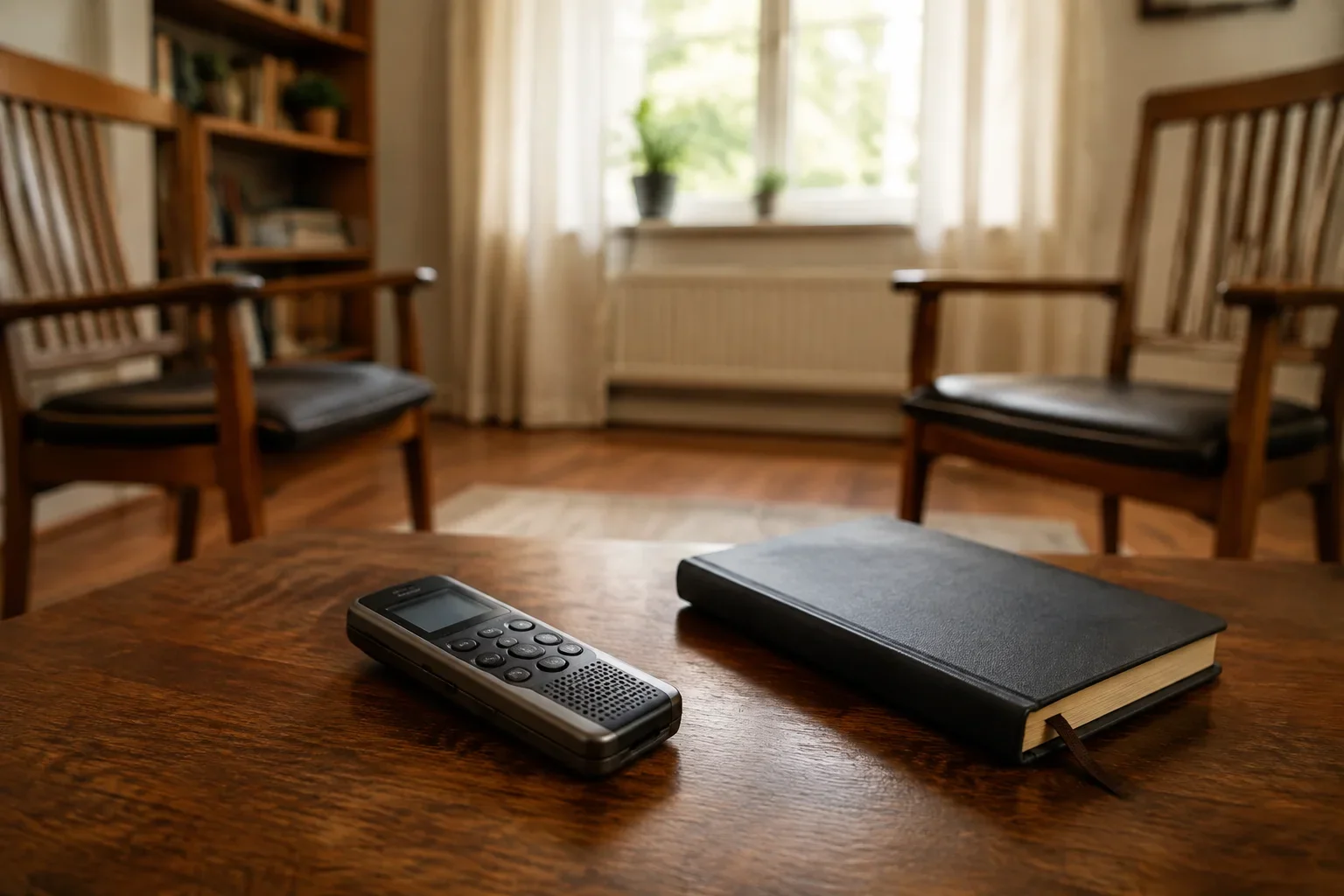
A cup, a bag, a map, or a room photograph can give you a prompt without displaying the Spanish answer. Choose one communicative task around it. With a cup, ask for a drink. With a map, ask where a place is. With a room picture, describe one feature you need to discuss with reception.
You can also describe what you are doing, but make the task realistic for your level. “Estoy en casa” means “I am at home.” “Quiero un café” means “I want a coffee.” These statements let you practice familiar language. A complicated account of everything in the kitchen may require so many unknown words that you barely speak.
When a word is missing, first see whether a gesture, description, or simpler sentence would preserve the message. Then note the useful missing expression for later. This keeps solo practice connected to communication instead of making it an exercise in translating your entire inner monologue. Use the vocabulary guide when you want to turn those missing expressions into review prompts.
Listen back for one question you can answer
Before playing your recording, decide what you are checking. Could someone identify the thing you asked for? Did your answer match the question? Was a particular word clear enough to distinguish it from another word? A narrow question makes the recording easier to use.
Do not grade your accent against an imagined perfect speaker. If you want to work on a sound, choose a reliable example and a specific word or short phrase. Compare that feature, then return it to the full request. A transcript can offer a clue about recognition, but automatic transcription is not a complete pronunciation assessment.
Save one change for the next attempt. You might need a clearer number, a question you can retrieve faster, or a way to ask for repetition. Trying to repair every detail in the recording can leave you with no time for another conversation. The mistake review guide shows how to turn one checked correction into a new prompt.
Try a complete solo café session
Set out a cup or a photograph of a café and prepare two customer requests. Keep the requests simple enough to understand fully. Put the Spanish models away before you start the recalled part of the session. Your first goal is to complete one exchange, not to fill a fixed number of minutes with continuous speech.
Run the first request as a supported exchange, then change where you want to drink the coffee. On the final attempt, answer a question before making any extra request. This checks whether you can follow the direction of the conversation, rather than always beginning with your favorite line.
If you get stuck, finish with a simpler answer and write down the missing detail. Do one checked repair and try it again after a short break. A session that reveals one useful gap and gives you another attempt has done worthwhile work, even when the first recording sounded hesitant.
- Listen to a short model request and confirm its meaning.
- Say the request while looking at the Spanish, then hide the line.
- Use an English situation prompt to make the request aloud.
- Play the here-or-takeaway question and answer it.
- Change the quantity or location, then record one fresh exchange.
- Check one difficulty and leave a prompt for your next session.
Add an unpredictable partner when you are ready
Solo work gives you room to prepare and repeat, but it cannot reproduce everything about another person's timing, word choice, or reaction. Use it to prepare for those exchanges. A classmate, tutor, conversation partner, or AI roleplay can introduce a reply you did not write yourself.
Tell the partner what you are working on. Ask for a short café scene with one follow-up question, or an introduction with a question about where you live. A focused task makes it easier to notice whether your solo practice transfers. You can expand the conversation once the small task is comfortable.
Yapkin provides guided lessons and conversation practice you can use alongside this routine. Keep the same small objective when you move into the app: make a request, respond to the reply, and review what was difficult. For a compact schedule, use the ten-minute Spanish routine, then return to a real exchange when you have the opportunity.
Common questions
Can I improve my Spanish speaking without a partner?
You can practice retrieving words, forming replies, and producing sounds alone. Use models and recordings so you have something to check. A partner adds unpredictable responses and feedback, so solo practice works well as preparation for interaction rather than a complete replacement for it.
Is reading Spanish aloud enough?
It is useful for practicing a written line, but it does not fully practice choosing words from a meaning. After reading, hide the sentence and answer a situation prompt. Then change a detail or respond to a question so you are producing a message of your own.
What should a complete beginner talk about?
Choose one familiar exchange with a clear outcome, such as ordering a drink, saying your name, or asking where something is. Learn a few checked lines first. You do not need to describe your whole day or maintain a long conversation before a short speaking session can be useful.
Should I talk to myself in Spanish all day?
You can use brief moments if you enjoy it, but you do not need to narrate everything. A focused exchange with a model, a hidden prompt, and a follow-up question gives you a clearer task to evaluate. Choose a routine you can repeat without constant dictionary searches.
How do I avoid practicing the wrong Spanish?
Start from reliable learner examples and confirm the meaning before repeating them. Check uncertain changes with a dictionary, learning resource, or knowledgeable speaker. When using AI feedback, ask for a context-specific explanation and verify surprising corrections instead of saving them automatically.
Sources and further reading


More practice guides
 Spanish routine 9 min read
A ten-minute Spanish routine you can repeat
Use ten minutes for Spanish listening, speaking, and review. Follow a practical routine with a worked café example and adjustments for busy or difficult days.
Read the guide Spanish vocabulary 9 min read
How to remember Spanish vocabulary for speaking
Remember Spanish vocabulary with useful phrases, hidden-answer prompts, and spaced review. Learn how to move from recognizing a word to using it in a reply.
Read the guide Review 9 min read
Make a mistake useful in your next conversation
Turn language mistakes into useful speaking practice. Check corrections, choose what to review, and build prompts that help you use the right phrase next time.
Read the guide