How to remember Spanish vocabulary for speaking
To remember Spanish vocabulary for speaking, learn a word in a useful phrase and practice recalling that phrase from a situation. Review it after a gap, then use it in a different relevant reply so recognition becomes usable language.


Quick answer
Choose words you expect to need, record their meaning and a checked example, and hide the Spanish before you answer a prompt. Learn the useful form of the word, including its article or phrase pattern. Revisit difficult items sooner and apply familiar ones in a new exchange.
In this guide
Decide what you want to do with the word
Recognizing a word in a menu and producing it during an order are different tasks. You might know that “leche” means milk as soon as you see it, yet struggle to request a coffee with milk without the menu in front of you. Your review should match the task you want to improve.
Choose a small situation first. If you are preparing for a café, words for drinks, quantities, and where to have the order belong together. A list that jumps from kitchen equipment to abstract politics may contain interesting words, but it is harder to turn into one manageable conversation.
Write the intended use beside each item. For “leche,” the use might be ordering a drink or asking what a drink contains. For “cuenta,” it might be requesting the bill in a restaurant. This prevents a familiar English translation from hiding the context you need. The same Spanish word can have other meanings in other settings.
Learn enough of the word to use it
A noun alone may not give you everything a sentence requires. Learn “la mesa” for the table rather than only “mesa,” and notice a useful plural such as “dos mesas” when it is relevant. You do not need to attach a complete grammar chapter to every word, but the form you save should help you build a real message.
For verbs, a useful phrase can be a better starting point than a long list of isolated infinitives. “Quiero un café” means “I want a coffee.” It gives you a request to understand and adapt. Later, you can study how “querer” changes with a different person or time. Do not assume that replacing the subject leaves every other word unchanged.
Check the word's meaning in your example. “La cuenta” can refer to the bill at a restaurant, but “cuenta” does not always mean a restaurant bill. Keep the situation with the phrase and use a dictionary entry with examples when a translation feels too broad. A little precision now avoids rehearsing a misleading equivalence.
| Bare item | More useful note | Situation prompt |
|---|---|---|
| leche = milk | Un café con leche, por favor. A coffee with milk, please. | Order a coffee with milk politely |
| mesa = table | Una mesa para dos, por favor. A table for two, please. | Ask a restaurant host for a table for two |
| cuenta = bill | La cuenta, por favor. The bill, please. | You have finished your meal and want to pay |
| repetir = repeat | ¿Puede repetir, por favor? Could you repeat, please? | You did not catch what a staff member said |
Use a scene as the prompt
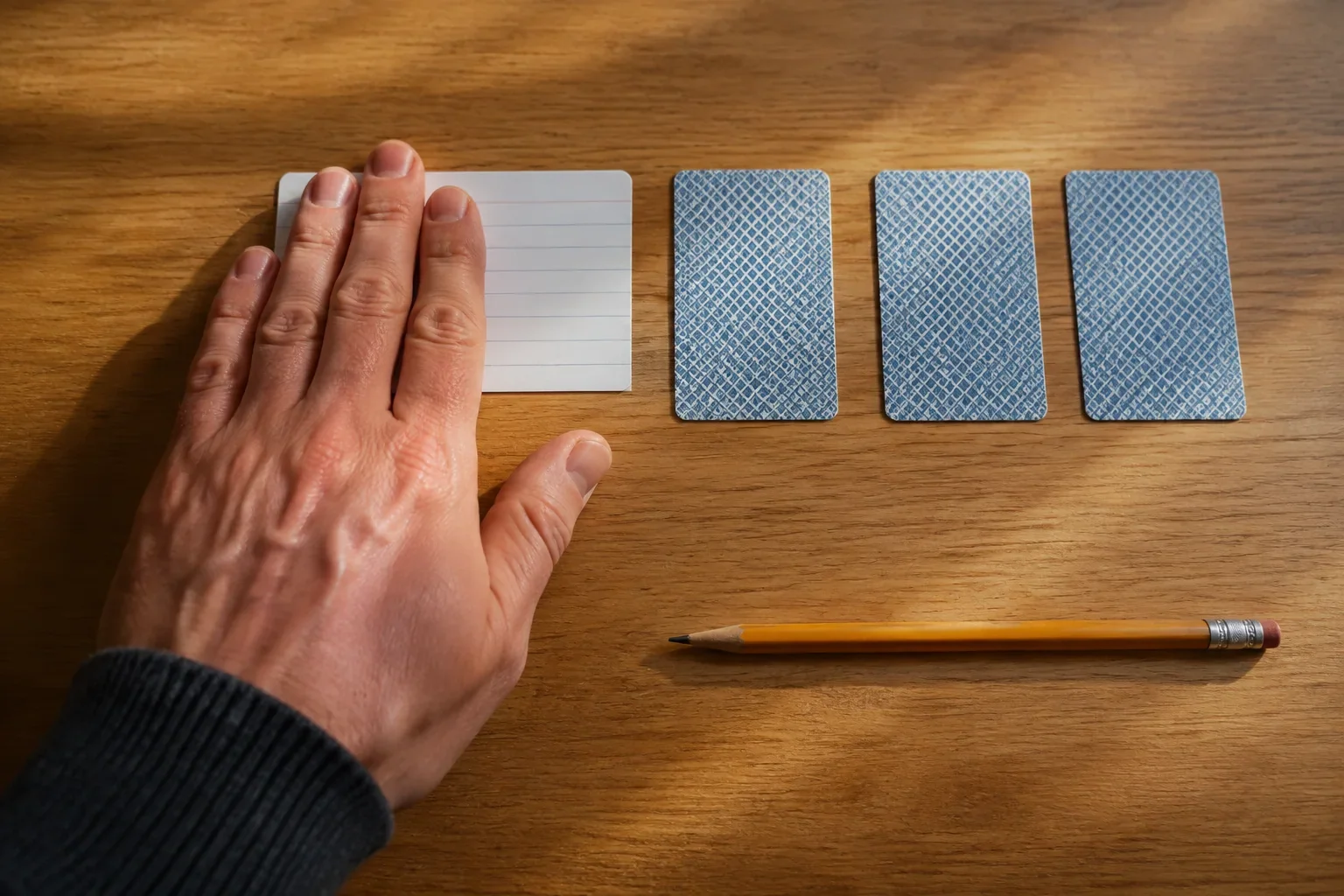
Put the meaning or situation on the front of a card and the Spanish example on the back. “You have finished your meal. Ask for the bill” requires you to retrieve useful language. A card that begins with “La cuenta…” may let you finish a familiar line without choosing it independently.
Pictures can also work when the meaning is clear. A picture of a lemon can prompt a word, but a picture of a busy restaurant may be too ambiguous unless you specify the action. Are you booking a table, asking for water, or paying? The best cue is the one that makes the intended message understandable without giving away the Spanish.
Keep alternative correct answers in mind. If you answer a restaurant prompt with another appropriate request, the fact that it differs from your card is not automatically a mistake. Use the model to check the target word or pattern, then evaluate whether your sentence communicates the situation. For a connected example, use restaurant Spanish.

Recall before you reread
Look at the prompt, attempt a reply, and only then reveal the answer. If you cannot remember the word, give yourself a brief attempt rather than an extended guessing session. Check the model, say it with the meaning in mind, and return to it after doing something else.
Research by Karpicke and Roediger used foreign-language vocabulary to examine retrieval and repeated study. It supports the value of actively recalling learned material rather than relying only on rereading. It does not mean every flashcard format is equally useful or that one successful recall guarantees effortless conversation.
Notice what your card actually tests. Spanish on the front and English on the back mostly asks you to recognize a meaning. A situation on the front and a spoken Spanish reply asks you to produce language. Both can be useful, but if speaking is your goal, include the second direction. Reading the answer silently is not the same practice as saying it.
You can do this with paper, a notes app, or a vocabulary tool. The medium matters less than whether the answer is hidden during the attempt and whether the prompt has a clear meaning. Keep the setup simple enough that creating cards does not consume all the time you intended to spend using them.
Review after a gap and adjust the interval
Try the item again later, when it is no longer held in mind from the previous repetition. You might return the next day and then after several days if it remains available. Treat that as a practical starting schedule. The appropriate gap depends on what you know, how difficult the item is, and when you need it.
If you fail repeatedly, inspect the card before adding more reviews. The cue may be vague, the example may contain too much new grammar, or the two sides may not describe the same meaning. A clearer prompt can be more helpful than showing a confusing card more often.
If recall is easy, change the context or allow a longer interval. Do not keep a word permanently in the easiest daily set because it gives you a satisfying correct answer. Bring it back when a conversation exposes a gap or when a coming situation makes it relevant again.
Spaced review is a way to organize return visits, not a promise that forgotten words indicate failure. Forgetting gives you information about what needs another attempt. Your job is to make that attempt meaningful enough to support the next time you need the word.
Make the word survive a follow-up question
Once you can request a coffee with milk, listen to a question about the order. “¿Uno o dos?” means “One or two?” Answer “Uno, por favor” or “Dos, por favor,” depending on what you want. Now your drink vocabulary belongs to an exchange with a decision, not only a card.
Then make a small change. Ask for a different drink whose name you have checked, or order for two people. Keep the new sentence natural. A word that shares an English translation with another word may not fit the same Spanish phrase. Check unfamiliar combinations instead of assuming every card can be mechanically substituted.
If the word disappears during the exchange, use a simpler description or ask for help, then note the exact gap afterward. Do not stop the entire conversation to rebuild your card system. The guide to freezing mid-sentence offers ways to keep the message moving, and solo speaking practice shows how to rehearse the follow-up turn.
Separate words that you keep confusing
When two items compete in memory, compare them in situations that reveal the difference. If you confuse words for a bill and a menu, practice two separate prompts: you have just sat down and want to choose food; you have finished eating and want to pay. The sequence of the meal gives each request a reason to exist.
Do not put a long explanation on the front of the card that tells you which Spanish answer to choose. Give the situation, attempt the request, then check the distinction. On another day, mix the prompts so their order no longer supplies the answer.
Some confusion comes from learning several near-synonyms before you need them. Keep one appropriate expression active and leave more specialized alternatives in a reference note. You can add them when you understand the setting or register they serve. More entries are not automatically more useful speaking vocabulary.
When feedback changes an example, check that it preserves the message before replacing the card. Our mistake review guide explains how to distinguish a correction of meaning or grammar from a stylistic alternative and how to rehearse the result in context.
Build a small set you can actually use
Choose a handful of words from one scene and give each one a useful job. For a café session, that could be a drink, a quantity, a preference, a question, and a way to ask for repetition. The exact number matters less than whether you have time to understand and retrieve the items.
Practice the cards separately, then combine a few in a short exchange. You do not have to force every new word into the same sentence. An overloaded sentence may be less natural and harder to assess than two clear turns. Finish by identifying the item that most affected your message.
The next session can begin with that prompt, then add a new detail if the earlier language is available. A ten-minute routine gives you a practical place to put this review alongside listening and speaking. Keep some time for actual replies; organizing vocabulary is preparation for using it.
- Choose a situation you expect to encounter.
- Select a few useful words or phrases from checked examples.
- Write a clear meaning or situation prompt for each item.
- Attempt a spoken answer with the Spanish hidden.
- Use two or three items in a short exchange.
- Return after a gap and change the prompts that caused confusion.
Common questions
Why do I recognize Spanish words but forget them when speaking?
Recognizing a visible word and retrieving it from an intended meaning require different practice. Add prompts that hide the Spanish and ask you to give a spoken reply. Keep the situation specific so you can evaluate whether you selected useful language, rather than only whether the word looked familiar.
Should I learn words or whole sentences?
Use both at a manageable scale. A word needs a clear meaning, and a useful phrase shows how it fits into speech. Avoid memorizing long sentences whose parts you do not understand. Start with a short, checked example and gradually adapt it to a different message.
How many Spanish words should I learn each day?
Choose an amount you can understand, review, and use in a reply. A small set from one situation is often easier to practice meaningfully than a large unrelated list. Reduce new material if your review becomes unmanageable, and do not treat a daily number as a guarantee of progress.
Do flashcards help with conversation?
They can support recall, especially when the prompt describes a situation and the answer is spoken. They do not provide all the listening, timing, or unpredictable replies of a conversation. Use cards to prepare useful language, then practice it in an exchange.
What should I do with a word I keep forgetting?
Check whether you understand its meaning and whether the prompt is clear. Add a useful example or separate it from a confusing near-synonym. Then make another hidden-answer attempt after a gap. If the word is not relevant to anything you expect to say, it may not need daily priority.
Sources and further reading
Related Spanish phrases



More practice guides
 Spanish speaking 9 min read
How to practice speaking Spanish alone
Practice Spanish speaking alone with short roleplays, recordings, and useful prompts. Learn how to choose examples and move beyond reading a script aloud.
Read the guide Spanish routine 9 min read
A ten-minute Spanish routine you can repeat
Use ten minutes for Spanish listening, speaking, and review. Follow a practical routine with a worked café example and adjustments for busy or difficult days.
Read the guide Review 9 min read
Make a mistake useful in your next conversation
Turn language mistakes into useful speaking practice. Check corrections, choose what to review, and build prompts that help you use the right phrase next time.
Read the guide