German question words that fit the answer
German question words name the information you need, such as wer for a person, wann for a time, and wo for a location. In an ordinary direct W-question, put the question word or phrase first and the conjugated verb next, as in "Wann beginnt der Kurs?", meaning "When does the course start?"


Quick answer
Choose the missing answer before choosing the word. Use wo for a location, wohin for a destination and woher for a source or origin. A question phrase can contain several words, as in "Um wie viel Uhr beginnt der Kurs?", meaning "At what time does the course start?" The whole phrase comes before beginnt. Yes/no questions and embedded questions use different patterns.
In this guide
Start with the answer you do not have
Imagine arriving for an evening class. You know the building, but not the room or the starting time. Asking whether the class exists will not supply either detail. Choose the gap first, then form the question that asks someone to fill it.
The table gives useful starting points, not a claim that German has a fixed number of question words. Some expressions are single words, while others combine a question word with a preposition, noun or adjective. The IDS explanation of interrogative elements distinguishes these different kinds of expression.
Read each question together with its reply. That makes the contrast more concrete than learning an English label alone. If you need an exact starting time, a reason or a person's name is still the wrong answer, even if you understood every word.
| Missing information | Question and meaning | A matching reply |
|---|---|---|
| A person, wer | Wer leitet den Kurs? Who leads the course? | Frau Berger. Ms. Berger. |
| A thing or activity, was | Was brauchen wir? What do we need? | Ein Heft. A notebook. |
| A time, wann | Wann beginnt der Kurs? When does the course start? | Um sechs Uhr. At six o'clock. |
| A location, wo | Wo ist der Kursraum? Where is the classroom? | Im ersten Stock. On the first floor above ground level. |
| A destination, wohin | Wohin gehen wir jetzt? Where are we going now? | Zum Kursraum. To the classroom. |
| A source, woher | Woher kommt der Bus? Where is the bus coming from? | Vom Bahnhof. From the station. |
| A reason, warum | Warum warten wir? Why are we waiting? | Der Raum ist noch geschlossen. The room is still closed. |
| A manner, wie | Wie bezahlen wir? How do we pay? | Mit Karte. By card. |
Keep location, destination and source apart
English often leaves the direction inside the verb and uses where for several jobs. German offers wo, wohin and woher to make the distinction explicit. Picture a point on a map, an arrow toward it and an arrow away from it. These are different questions, even when they concern the same building.
"Wo bist du?" means "Where are you?" You could answer "Ich bin am Bahnhof", meaning "I am at the station". For a destination, ask "Wohin gehst du?", meaning "Where are you going?" A matching reply is "Ich gehe zur Bibliothek", meaning "I am going to the library".
For the starting point, "Woher kommst du gerade?" means "Where are you coming from right now?" The reply "Ich komme vom Bahnhof" means "I am coming from the station". Here, gerade means "right now" and helps show that you mean the current journey rather than the person's origin. A question with woher can also concern a person's origin, depending on the situation.
Do not turn this into a rule that every verb involving movement requires wohin. A person can run inside a park without the question asking for a destination. Ask yourself whether you want the place where an activity happens or the place someone is heading. Then check the complete sentence, including its preposition.

Count the question phrase as one position
In the ordinary direct W-question, the conjugated verb follows the opening question phrase. The conjugated verb agrees with the subject. Compare "der Kurs beginnt", meaning "the course starts", with "die Kurse beginnen", meaning "the courses start". This word-order rule concerns the conjugated verb, not every verb form in the sentence.
Compare "Wann beginnt der Kurs?", meaning "When does the course start?", with "Um wie viel Uhr beginnt der Kurs?", meaning "At what time does the course start?" The second question has several words before beginnt. They belong to one question phrase. Verb second means second position in this structure, not necessarily the second written word.
A modal gives you two verb forms to place. "Wann können wir anfangen?" means "When can we start?" Können is the conjugated verb after wann. The infinitive anfangen stays at the end. Keep the pair together when practicing instead of moving both verbs next to the question word.
For a yes/no question, begin with the conjugated verb. "Beginnt der Kurs um sechs Uhr?" means "Does the course start at six o'clock?" You are checking a proposed time rather than asking for an unknown one. Do not add a separate German equivalent of English does. Lingolia's question guide sets out the basic open and closed patterns.
Choose wer, wen or wem for the person's role
Wer, wen and wem can all refer to a person, but they do different jobs in a sentence. The English word who does not tell you which German form to use. Start with the verb and the relationship you are asking about, not a habit of choosing wer for every person.
"Wer besucht den Kurs?" means "Who attends the course?" Wer is the subject, the person attending. There is no extra du or Sie after besucht because the question already asks who the subject is. The useful beginner pattern here is wer followed by a third-person singular verb.
"Wen besucht Anna?" means "Who does Anna visit?" Anna is the subject, while wen asks for the person she visits. "Wem hilft Anna?" means "Who does Anna help?" Helfen takes a dative object, so the question uses wem. This is not an instruction to use wem for every English sentence containing help in some other construction.
The IDS entry on W-pronouns records these case forms and their sentence roles. Learn a checked question with its verb while your case knowledge grows. Keep the choice of case separate from the choice between du, ihr and Sie, which concerns whom you are addressing.
Follow the missing details through one exchange
This invented exchange takes place at a cultural center. The visitor and receptionist use formal Sie. The room, teacher and times are practice details, not information about a real course. Notice that each new question asks for a different kind of answer instead of repeating a memorized introduction.
Visitor: "Guten Abend. Wo findet der Zeichenkurs statt?" This means "Good evening. Where does the drawing class take place?" Receptionist: "Im ersten Stock, in Raum vier." This means "On the first floor above ground level, in room four".
Visitor: "Um wie viel Uhr beginnt er?" This means "At what time does it start?" Receptionist: "Um achtzehn Uhr. Sie haben noch zehn Minuten." This means "At six p.m. You still have ten minutes".
Visitor: "Wer leitet den Kurs heute?" This means "Who leads the class today?" Receptionist: "Frau Berger." This means "Ms. Berger". Visitor: "Was brauche ich?" This means "What do I need?" Receptionist: "Nur einen Bleistift. Papier bekommen Sie dort." This means "Only a pencil. You will get paper there".
The visitor now has a location, a time, a teacher and a required item. Cover the questions and try reconstructing them from the receptionist's answers. Then change just one fact. If you practice arranging times rather than arriving for a class, the German appointment guide gives you a separate booking task.
Choose a question from five answer cards
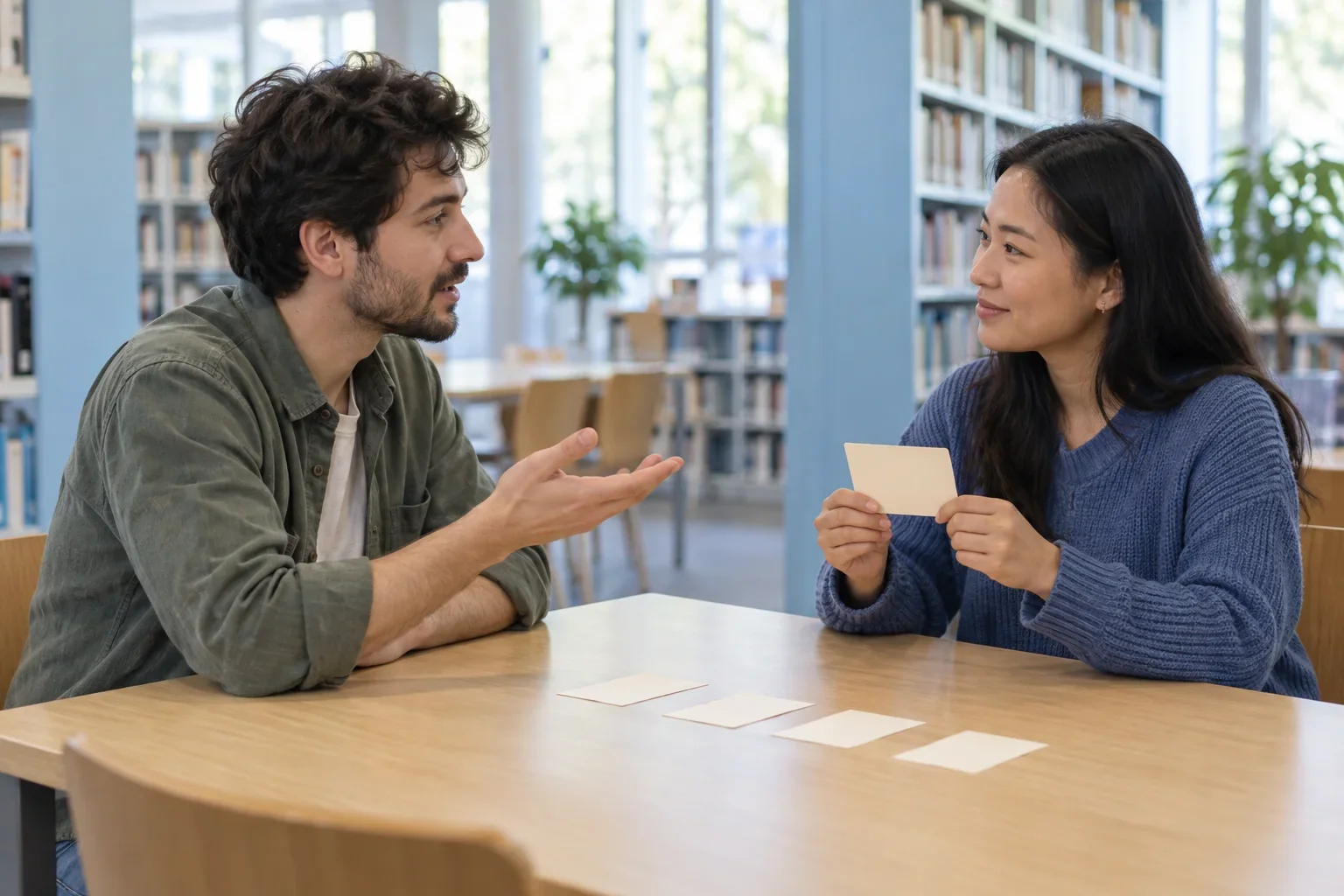
For each card, ask about the missing detail in German before reading the answer key. More than one natural question can fit an answer. The goal is to supply a sensible question with the right meaning and structure, not to reproduce one secret sentence word for word.
Card one. A friend says "Ich bin in der Bibliothek", meaning "I am in the library". Ask for their current location. Card two. They say "Ich gehe zum Bahnhof", meaning "I am going to the station". Ask for their destination. Keep those two cards beside each other so you cannot answer both by habit.
Card three. At reception, the answer is "Um neunzehn Uhr", meaning "At seven p.m.". Ask when the film starts. Card four. A friend says "Anna hilft mir", meaning "Anna is helping me". Ask who is helping them. Card five. You learn that a course costs forty euros. Ask for its price.
After each attempt, predict the kind of reply you should hear. A time, person or amount is enough for this check. This follows the practical approach in listening for meaning. You can understand the sentence structure and still miss the detail needed to continue.
Check why each question fits
For card one, "Wo bist du?" means "Where are you?" The answer gives a current location. For card two, "Wohin gehst du?" means "Where are you going?" The answer names a destination. Swapping wo and wohin changes the information you request, rather than making the same question more or less polite.
For card three, "Wann beginnt der Film?" means "When does the film start?" You can also ask "Um wie viel Uhr beginnt der Film?", meaning "At what time does the film start?" The longer opening is one phrase. For card four, "Wer hilft dir?" means "Who is helping you?" Wer asks for the helper, and dir addresses the friend who receives the help.
For card five, "Wie viel kostet der Kurs?" means "How much does the course cost?" Wie viel asks for an amount. "Was kostet der Kurs?" is another natural way to ask the same price question. Both fit this card.
If a question went wrong, record both your intended answer type and the corrected question. Those two lines make a better review prompt than copying a rule without a situation. Once you can answer, replace the class with an object at a shop and check the new noun and verb forms.
Notice when a question sits inside a sentence
The direct pattern does not apply unchanged inside an indirect question. Compare "Wo ist der Kursraum?", meaning "Where is the classroom?", with "Wissen Sie, wo der Kursraum ist?", meaning "Do you know where the classroom is?" In the embedded clause "wo der Kursraum ist", the conjugated verb ist comes at the end.
The outer question begins with Wissen Sie, while the inner question has its own word order. The IDS description of W-clauses gives examples of this embedded structure. For now, recognize the difference and practice the whole checked sentence. You do not need to turn every short direct question into a longer request.
Finish your session by choosing one place, one time and one person from your own plans. Write a matching question for each, hide it and try asking aloud from the answer alone. On the next attempt, change which detail is missing. That tests whether you chose the question yourself instead of only remembering its place in a list.
Common questions
What are the main German question words?
Useful starting words are wer for who, was for what, wann for when, wo for where, warum for why and wie for how. Add wohin for a destination and woher for a source or origin. German also has longer question phrases, so there is no single fixed count that covers every question.
Does the verb always come second in German questions?
No. In an ordinary direct W-question, the conjugated verb follows the opening question phrase. A yes/no question usually starts with that verb. "Wissen Sie, wo der Raum ist?" means "Do you know where the room is?" In the embedded clause "wo der Raum ist", ist comes at the end.
What is the difference between wo, wohin and woher?
Wo asks for a location, wohin for a destination and woher for a source or origin. Wo bist du? means Where are you? Wohin gehst du? means Where are you going? Woher kommst du gerade? means Where are you coming from right now? Choose by the information you need, not just whether the verb describes movement.
Why does a question with wer sometimes have no other subject?
Wer can itself be the subject. Wer leitet den Kurs? means Who leads the course? The question asks which person leads it, so you do not add du or Sie as another subject. If someone else is already the subject, the person you ask about may need wen or wem, depending on the construction.
How can I practice question words without memorizing a list?
Write a short answer that gives a place, time, person or amount. Hide a checked matching question and try asking it yourself. Then change the answer type. Compare your question with the model for meaning and verb placement, while allowing other natural wording that asks for the same information.
Sources and further reading
More practice guides
 German · Grammar in conversation 9 min read
Du, ihr, or Sie? German address in real situations
Choose du, ihr, or Sie in German, recognize formal address in speech and writing, and practice changing verbs and questions through translated situations.
Read the guide German · Everyday arrangements 9 min read
Make, confirm, and move an appointment in German
Arrange an appointment in German, compare available times, spell your name, and reschedule clearly with translated calls, message examples, and practice.
Read the guide German · Food and shopping 9 min read
Choose bread and order at a German bakery
Order bread and rolls in German, ask for a sliced loaf, understand counter questions, and change an order using translated examples and practical exercises.
Read the guide