Spanish hotel phrases for a simple check-in
At a hotel in Spanish, start with “Tengo una reserva a nombre de…” and the name on your booking. Confirm the practical details one at a time, including breakfast, the room location, and departure time, rather than trying to understand a long explanation all at once.

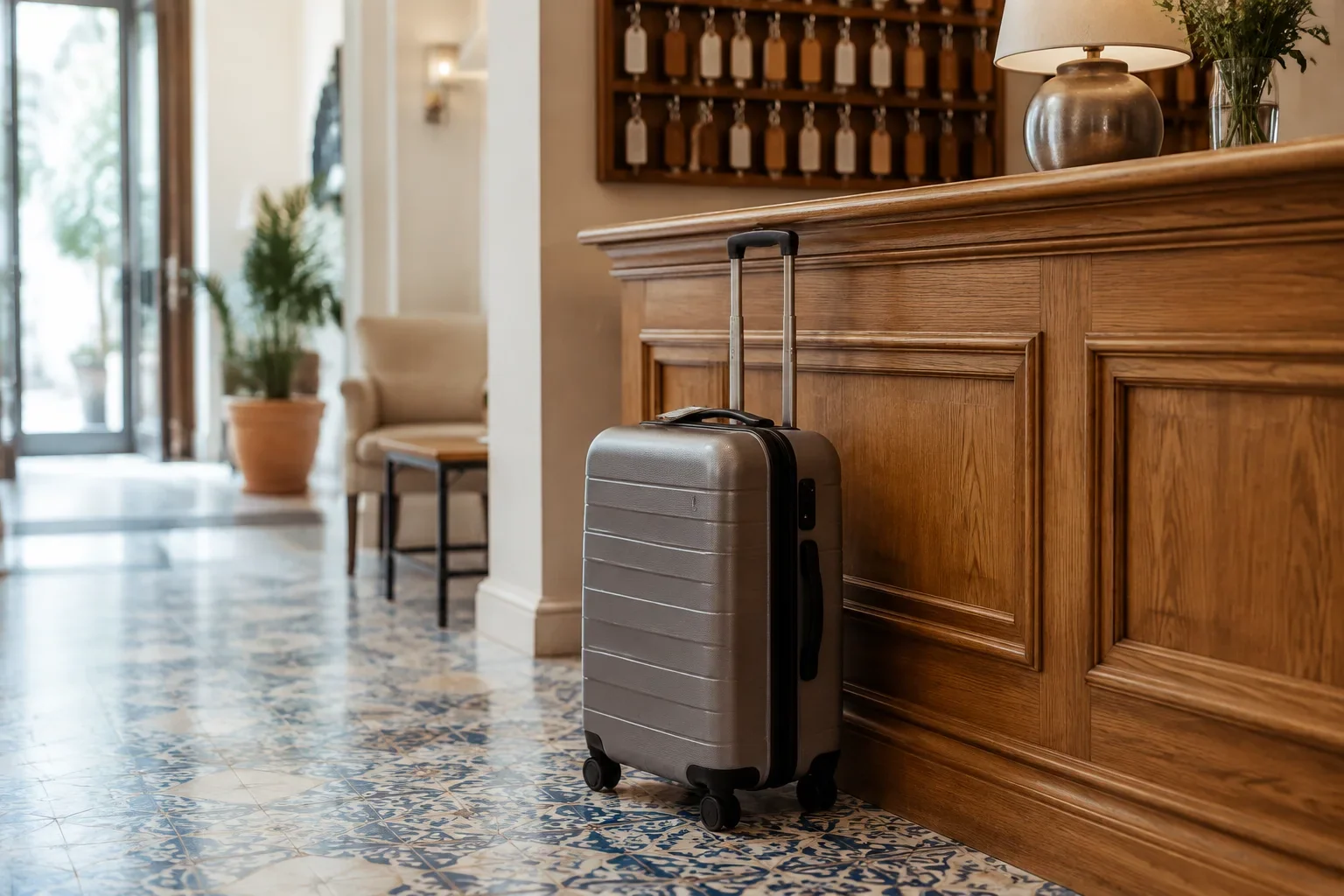
Quick answer
“Tengo una reserva” means “I have a reservation.” Give the booking name, listen to the receptionist's question, and confirm any date or detail you missed. Ask “¿A qué hora es el desayuno?” for breakfast time and “¿A qué hora tengo que dejar la habitación?” for the time you need to leave the room.
In this guide
Five phrases to have ready
Tengo una reserva.
I have a reservation.
A clear opening when you reach reception.
La reserva está a nombre de Alex Lee.
The reservation is under the name Alex Lee.
Replace the example name with the name on your booking.
¿A qué hora es el desayuno?
What time is breakfast?
Expect a time or a range of times in the answer.
¿Cuál es la contraseña del wifi?
What is the Wi-Fi password?
You can ask the receptionist to show you the written password.
¿A qué hora tengo que dejar la habitación?
What time do I need to check out of the room?
Literally, this asks when you have to leave the room.
A short conversation
Hola, tengo una reserva.
Hello, I have a reservation.¿A qué nombre?
Under what name?A nombre de Alex Lee.
Under the name Alex Lee.Aquí está. Bienvenido.
Here it is. Welcome.Match your opening to whether you have a booking
If you already booked, say “Hola. Tengo una reserva a nombre de Ana Ruiz.” This means “Hello. I have a reservation under the name Ana Ruiz.” Replace the name with the one on the booking. If another person made the reservation, their name may be the useful starting point rather than your own.
If you have not booked, “¿Tienen una habitación disponible?” means “Do you have a room available?” That is a different request. The receptionist will need to know dates, the number of people, and other details before answering fully. Do not use “Tengo una reserva” just because it is the first hotel phrase you learned.
Keep the booking confirmation available to show when needed. Written information supports the exchange and can clarify a name that is unfamiliar to the listener. You can still use Spanish to explain what you are showing. A clear opening and a document can work together without turning the check-in into a language test.
For practice, choose either an existing reservation or a walk-in request. Mixing both scenarios in the first attempt can make the conversation internally inconsistent. Add a different scenario after you can complete the first one.
Give the name and confirm the stay
The receptionist may ask “¿A nombre de quién?” meaning “Under whose name?” Give the booking name clearly. If spelling is needed, “Se escribe…” means “It's spelled…” before you spell it out. Practice the letters you need with a reliable model if this is likely to be part of your trip.
You may also hear “¿Para cuántas noches?” for “For how many nights?” or “¿Cuántas personas?” for “How many people?” A short answer such as “Dos noches” or “Dos personas” gives the requested information. Listen to which quantity the question asks about before answering with a memorized number.
Dates deserve particular attention. Repeat the relevant date or show the confirmation when you are unsure. A fluent-sounding answer is not useful if it confirms a different arrival or departure day. In practice, change the number of nights and people independently so you learn to distinguish the questions.
The receptionist may request documents or additional booking information according to the hotel's process. Respond to the actual request and ask for clarification if necessary. This guide prepares the conversation; it does not establish a universal check-in policy for every property or country.
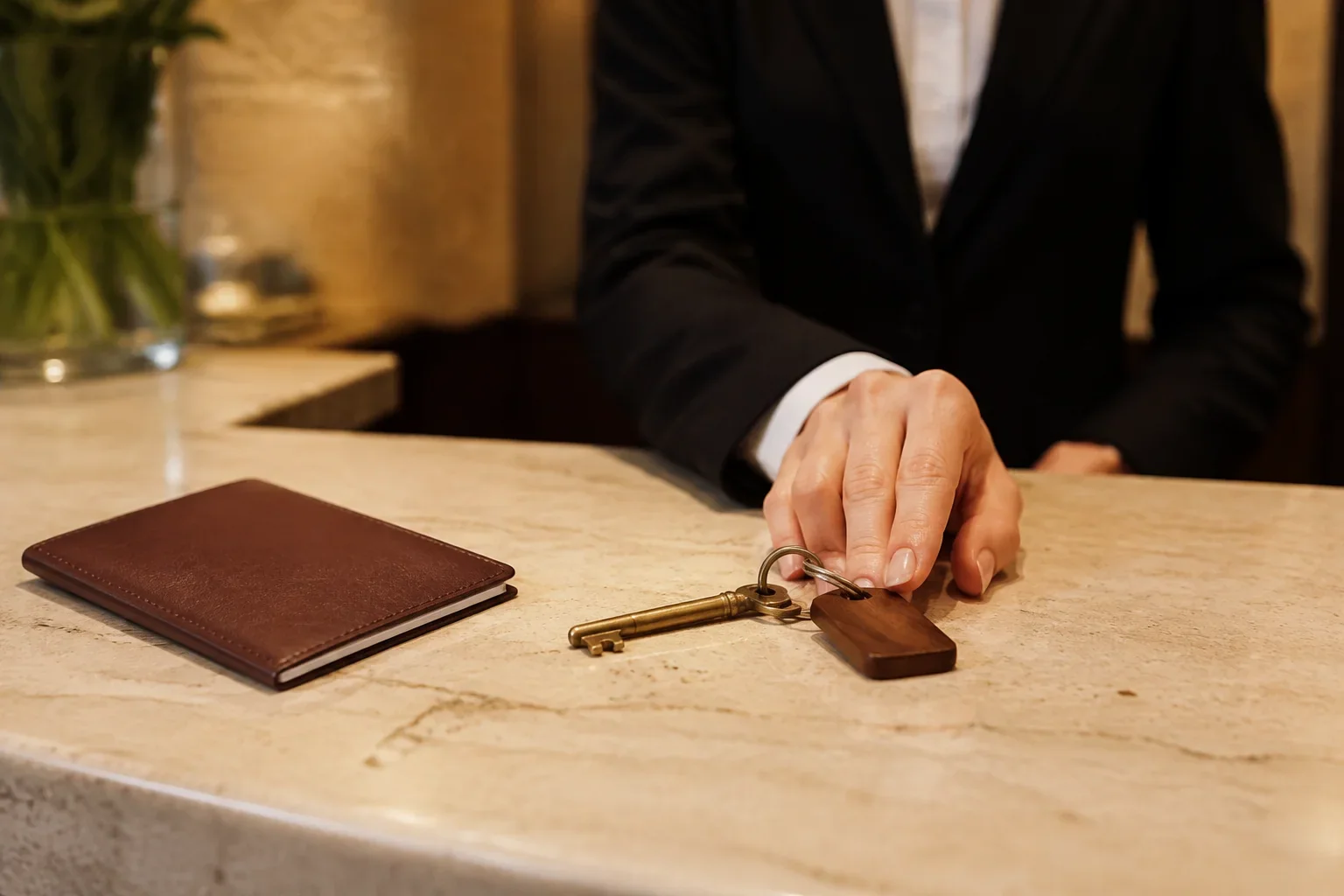
Ask about breakfast without assuming it is included
“¿A qué hora es el desayuno?” means “What time is breakfast?” It asks about the schedule. If you need to know whether breakfast is included in your booking, ask “¿Está incluido el desayuno?” meaning “Is breakfast included?” These questions solve different practical problems.
A breakfast explanation may contain both a start and an end time. “De siete a diez” means “From seven to ten.” Make sure you hear the whole range, not just the first familiar number. If you missed it, repeat the part you think you understood as a question and let the receptionist confirm.
You can ask “¿Dónde se sirve el desayuno?” for “Where is breakfast served?” The answer may refer to a floor, a room, or a nearby building. If the location is unclear, ask the receptionist to point it out. Breakfast practice is a useful way to connect time questions with simple indoor directions.
Do not infer a price or inclusion from a photograph of a breakfast room or from a generic room description. Ask about your booking. In a roleplay, let one reservation include breakfast and another require an additional arrangement, so your response depends on the answer rather than on an assumed yes.
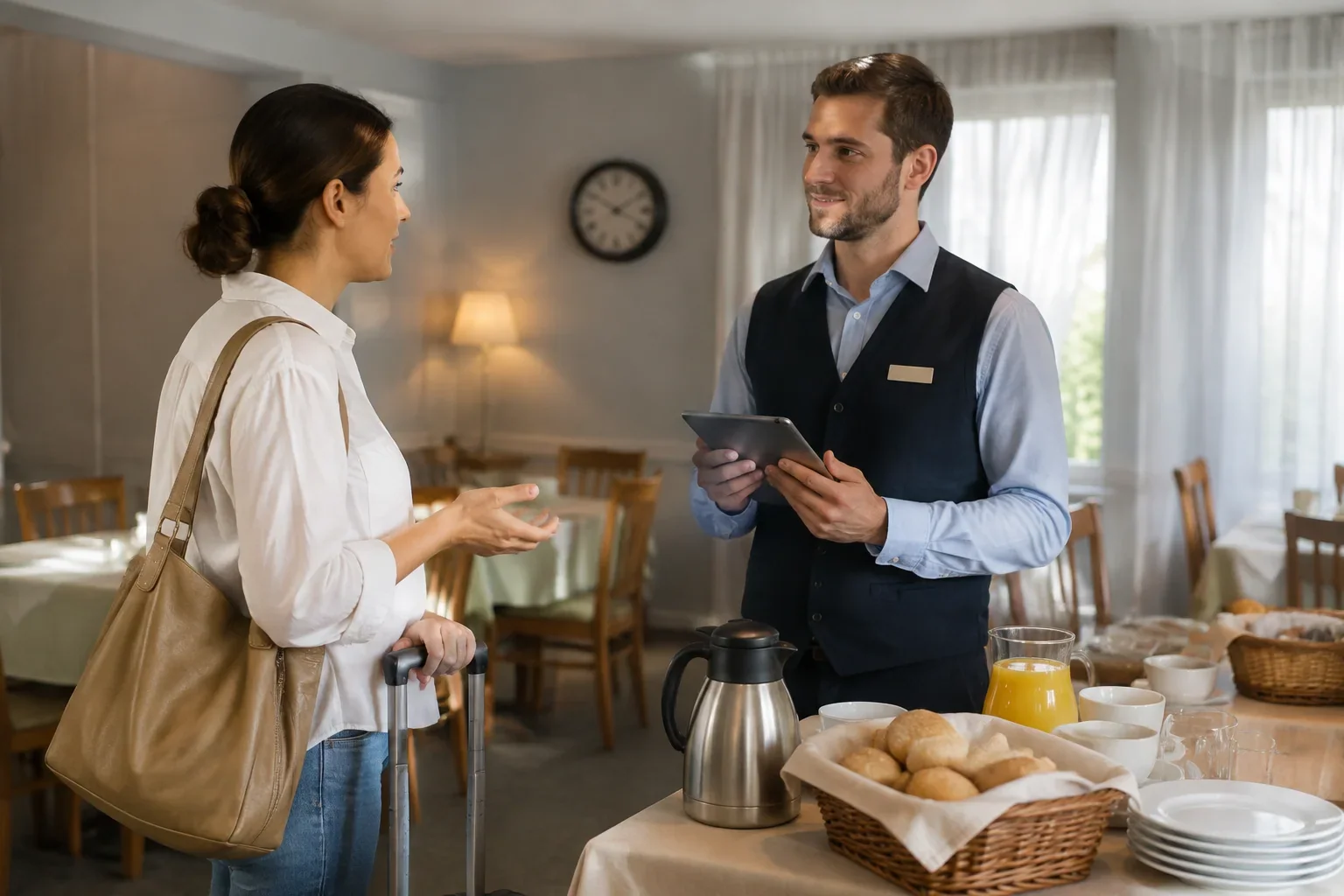
Locate the room and the facilities you need
“¿Dónde está mi habitación?” means “Where is my room?” The receptionist will often explain the location while giving you a key or card. Listen for the room number and the route together. A correct number is not enough if you head to the wrong part of the building.
“¿Dónde está el ascensor?” asks “Where is the lift?” In some places, “elevador” is used instead of “ascensor.” You may also hear “las escaleras,” meaning the stairs. Use the hotel's signs and the person's gesture to connect the word to the actual route.
Floor labels can follow different local conventions, so confirm the relevant button or sign when you are uncertain. You can ask a short question while pointing rather than guessing from how your home country numbers floors. The same principle applies to a room number that sounds similar to another number.
For a broader method of following a route, use asking for directions in Spanish. Indoors, the landmarks may be reception, the lift, or the dining room, but the task is still to understand an action in relation to a place.
| Spanish | Meaning | Detail to listen for |
|---|---|---|
| ¿A qué hora es el desayuno? | What time is breakfast? | The start and end of the service |
| ¿Está incluido el desayuno? | Is breakfast included? | Whether your booking includes it |
| ¿Dónde está el ascensor? | Where is the lift? | The route or direction |
| ¿Cuál es la contraseña del wifi? | What is the Wi-Fi password? | The written password or access instructions |
| ¿A qué hora tengo que dejar la habitación? | What time do I need to leave the room? | The departure time for your stay |
Ask for a written detail when precision matters
A Wi-Fi password, room number, or departure time may be easier to confirm in writing. “¿Puede escribirlo, por favor?” means “Could you write it down, please?” Use it for the specific detail you need instead of asking the receptionist to repeat a long explanation unchanged.
“¿Cuál es la contraseña del wifi?” asks “What is the Wi-Fi password?” The answer may be a code, a card, or instructions to connect through a page. Follow the hotel's actual process. Do not assume every connection uses a single password because your practice example did.
For checkout, “¿A qué hora tengo que dejar la habitación?” asks “What time do I need to leave the room?” It is longer than some beginner phrases, so learn it as a meaningful question and practice it in parts before using it without support. You may hear shorter wording about “la salida,” the departure or checkout.
If you need to leave luggage after checking out, ask “¿Puedo dejar aquí mi equipaje?” meaning “Can I leave my luggage here?” This requests an arrangement; it does not assume the service is available. Listen for where, until when, and any other detail the staff need to explain.
Explain one room problem clearly
A useful problem report names what is wrong and lets staff respond. “La tarjeta no funciona” means “The card doesn't work.” At reception, that gives a clear starting point if the room key card is not opening the door. Add your room number when requested.
“No hay agua caliente” means “There is no hot water.” It describes the issue without guessing its cause. You do not need to diagnose the plumbing in Spanish before asking for help. Staff may ask when the problem started or whether you have tried something, so leave space for the next question.
“¿Puede ayudarme, por favor?” means “Could you help me, please?” It is useful after describing the issue or when you need to begin a request. If you want something specific, such as another towel, ask directly: “¿Me puede traer otra toalla, por favor?” means “Could you bring me another towel, please?”
Practice one problem per exchange. A long list of unrelated complaints can be difficult to follow in any language. State the most useful detail, hear the response, and confirm the proposed next step before adding another issue.
Check the plan instead of saying yes automatically
A receptionist may propose a solution, explain a delay, or ask you to return later. If you only recognize a time or room number, confirm what that detail refers to. Does the time describe when breakfast ends, when a room will be ready, or when someone will come to help?
You can repeat a short part as a question, ask for slower speech, or request writing. The help phrases guide explains which request fits each difficulty. Use “¿Puede repetir, por favor?” when repetition would resolve the gap, and a more specific question when you need a different explanation.
During practice, include one reply that changes your plan. Perhaps the room is not ready yet or breakfast is served in a different area. Your task is to understand the arrangement and respond, not to force the receptionist back to the line you expected.
If listening to these practical details is the recurring difficulty, use our listening-for-meaning guide. If the issue is retrieving your own question, the solo speaking guide gives you a way to practice it with the written answer hidden.
Rehearse arrival, one question, and one problem
Prepare a fictional booking with a name, number of nights, and number of guests. Keep those facts visible in English while you practice the Spanish exchange. This gives you something to communicate without displaying the wording of your answers.
First complete the arrival conversation. On the next attempt, add a breakfast question. On a later attempt, return to reception with one room problem. The three scenes share useful language but have different outcomes, so you can see which part needs more work.
Use the ten-minute Spanish routine to fit one of these scenes into a short session. Listen to a model, answer a prompt, and check one difficulty. If you receive a correction, make sure it preserves the booking detail or request you actually intended.
A useful final check is practical: could you identify the stay, understand the next step, and ask about the detail you needed? You do not have to understand every word in a long welcome speech to complete those tasks, but you should confirm anything that affects your plans.
- Create a fictional booking and state that you have a reservation.
- Answer a question about the booking name or length of stay.
- Ask one breakfast question and confirm the answer.
- Ask for a written detail such as a password or departure time.
- Rehearse one room problem and respond to the proposed solution.
- Repeat with a changed booking detail rather than memorizing both roles.
Common questions
How do I say I have a reservation in Spanish?
Say “Tengo una reserva.” To give the booking name, add “a nombre de…” followed by the name on the confirmation. If someone else made the reservation, use the name that lets reception find it rather than assuming your own name will be listed.
How do I ask whether breakfast is included?
Use “¿Está incluido el desayuno?” That asks about inclusion in your booking. “¿A qué hora es el desayuno?” asks about the time instead. Prepare both questions if you need both details, and listen to the answer for your actual reservation.
How do I ask for checkout time?
“¿A qué hora tengo que dejar la habitación?” means “What time do I need to leave the room?” Ask the staff to repeat or write the time if you are unsure. The phrase helps you request the information; the property determines the actual checkout arrangement.
What should I say if my key card does not work?
Say “La tarjeta no funciona,” meaning “The card doesn't work,” and explain that you mean your room card. Give the room number when needed and let reception ask any follow-up questions. You do not need to guess the technical cause before reporting the problem.
How can I practice hotel Spanish without memorizing a script?
Use a fictional booking and answer questions about its details with the Spanish hidden. Change the number of nights, ask a different breakfast question, or introduce one room problem. The new detail makes your reply depend on the situation instead of a fixed order of lines.
Sources and further reading
Related Spanish phrases
Finding your way
Ask where the station is and recognize left, right, and straight ahead.
Explore the phrases
When you need a hand
Ask someone to repeat or slow down without switching the entire conversation to English.
Explore the phrases
At the restaurant
Ask for a table, make a simple order, and request the bill.
Explore the phrases
Buying train tickets
Choose a journey and confirm the details before paying.
Explore the phrasesMore practice guides
 Spanish speaking 9 min read
How to practice speaking Spanish alone
Practice Spanish speaking alone with short roleplays, recordings, and useful prompts. Learn how to choose examples and move beyond reading a script aloud.
Read the guide Spanish routine 9 min read
A ten-minute Spanish routine you can repeat
Use ten minutes for Spanish listening, speaking, and review. Follow a practical routine with a worked café example and adjustments for busy or difficult days.
Read the guide Listening 10 min read
How to practice listening for meaning
Practice listening without catching every word. Give a short recording one question to answer, find what you missed in the transcript, and listen again.
Read the guide